Systemic wage theft has long been part of the labour migration landscape in every region of the world. During COVID-19, egregious underpayment of migrant workers was even more widespread as businesses encountered financial pressures and vast numbers of workers were repatriated without payment of their wages. Though every jurisdiction has judicial and/or administrative mechanisms to address wage claims, employers in every country can be confident that very few unpaid migrant workers will ever use those mechanisms to recover their wages. This is because the system is stacked against them at every stage in the wage claim process.

The failure of government and judicial wage recovery mechanisms is not inevitable. This report documents a range of initiatives from around the world that seek to disrupt employer expectations of impunity and enable migrant workers to bring claims and obtain redress for wage theft. These specific, practical reform targets can form the basis of collaborative and evidence-based wage theft campaigns on a global, national and local scale.

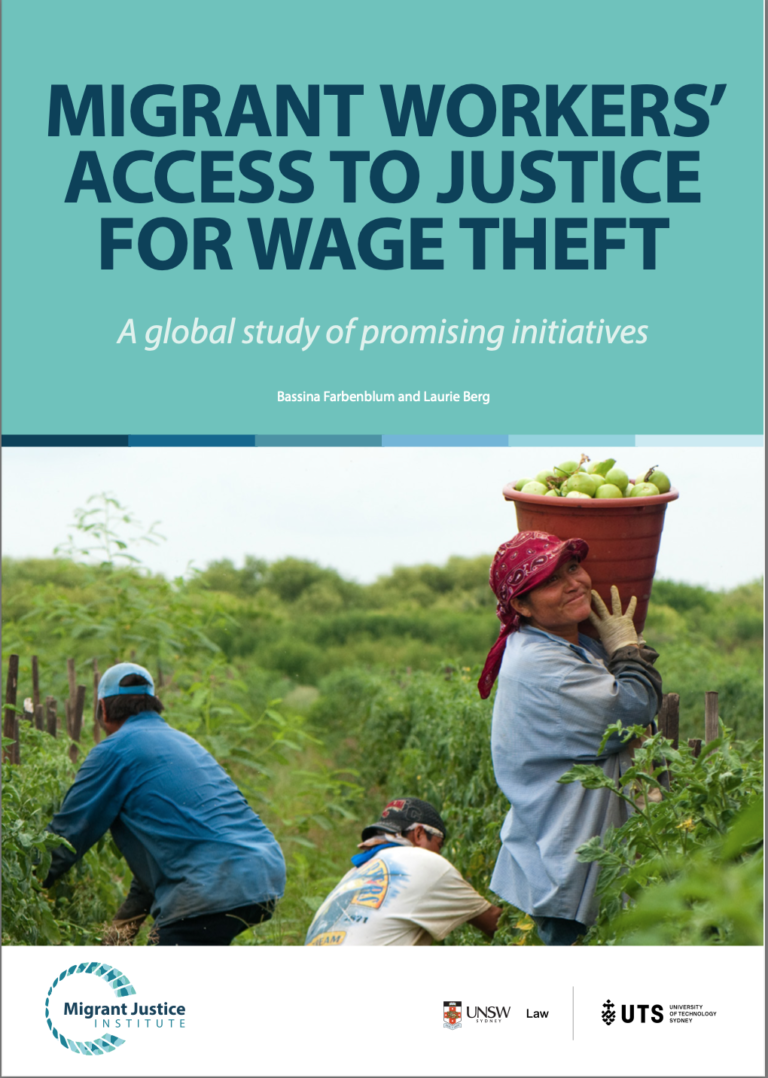
Migrant workers' access to justice for wage theft: A global study of promising initiatives - Bassina Farbenblum and Laurie Berg 2021 DOWNLOAD

post

page

attachment

revision

nav_menu_item

custom_css

customize_changeset

oembed_cache

user_request

wp_block

wp_template

wp_template_part

wp_global_styles

wp_navigation

wp_font_family

wp_font_face

acf-taxonomy

acf-post-type

acf-field-group

acf-field

ai1ec_event

exactmetrics_note

OECD-FAO Guidance for Responsible Agricultural Supply Chains
Guidance

The OECD-FAO Guidance for Responsible Agricultural Supply Chains (the Guidance) has been developed to help enterprises observe existing standards for responsible business conduct along agricultural supply chains. These standards include the OEC...Read More

Trafficked third-country nationals: Detection, identification and protection in Austria
Guidance

Trafficking in human beings is a serious violation of human rights and human dignity, and is considered one of the worst crimes of all (Federal Ministry for European and International Affairs, n.d.).As a global phenomenon that can only be tackled at...Read More

The COVID-19 Pandemic and Workers in Cambodia: A Survey of Suspended Workers in Four Sectors: Garment Manufacturing, Footwear and Travel Foods, Hotels and Guesthouses, and Other Tourism Services
COVID-19 resourcesGuidance

In Cambodia, the COVID-19 pandemic has resulted in widespread job suspensions and losses, and substantial reductions of income for workers and their families. By June 2020, as many as 234 factories in the manufacturing sectors (garment, footwear and...Read More

Guidance on operational practice & indicators of forced labour
Guidance

The International Labour Organization (ILO) estimates on its website that at least 21 million people worldwide are victims offorced labour. Of these, the ILO finds 14.2 million (or 68 per cent) are victims of forced labour exploitatio...Read More