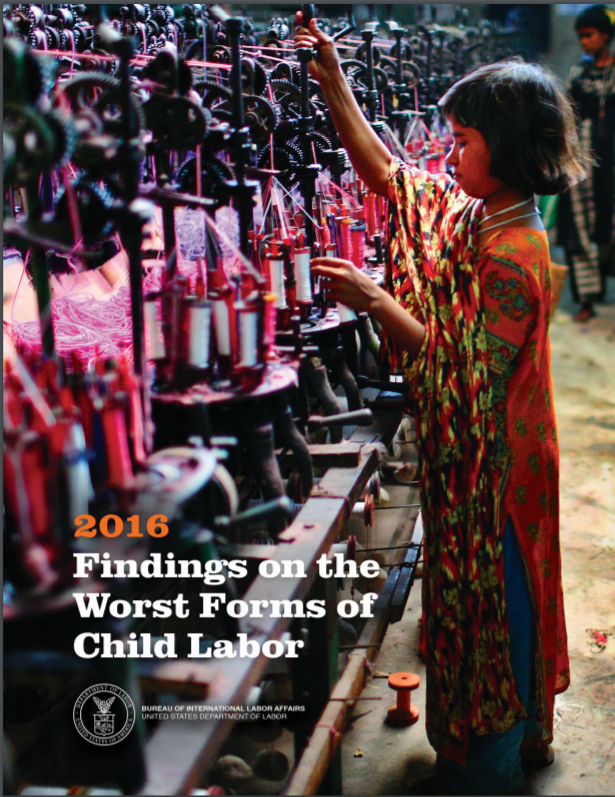
The U.S. Department of Labor (USDOL) has prepared this 16th annual report on 2016 Findings on the Worst Forms of Child Labor in accordance with the Trade and Development Act of 2000 (TDA).

This report focuses on the worst forms of child labour. The definition of the “worst forms of child labour” is found in the TDA and is the same as that included in ILO C. 182. It includes (a) all forms of slavery or practices similar to slavery, such as the sale or trafficking of children, debt bondage and serfdom, or forced or compulsory labour, including forced or compulsory recruitment of children for use in armed conflict; (b) the use, procuring, or offering of a child for prostitution, for the production of pornography, or for pornographic purposes; (c) the use, procuring, or offering of a child for illicit activities, in particular for the production and trafficking of drugs; and (d) work which, by its nature or the circumstances in which it is carried out, is likely to harm the health, safety, or morals
of children.

post

page

attachment

revision

nav_menu_item

custom_css

customize_changeset

oembed_cache

user_request

wp_block

wp_template

wp_template_part

wp_global_styles

wp_navigation

wp_font_family

wp_font_face

acf-taxonomy

acf-post-type

acf-field-group

acf-field

ai1ec_event

exactmetrics_note

COVID-19 Impact on Child Labour and Forced Labour: The Response of the IPEC+ Flagship Program
COVID-19 resourcesPublications

The ILO’s Flagship International Programme on the Elimination of Child Labour and Forced Labour (IPEC+) has ongoing operations in 62 countries, all of which are affected by the COVID-19 pandemic. The programme has developed business continuity pla...Read More

TAGS: Global
The new slavery: Kenyan workers in the Middle East
Publications

Written by Mohamed Daghar. In September 2014 Kenya banned the exportation of labour to the Middle East because workers were being trafficked by criminal networks offering them jobs. This policy brief focuses on the criminals who continue to driv...Read More

Sextortion: Findings from a Survey of 1,631 Victims
Publications

Janis Wolak and David Finkelhor Sextortion is defined as threats to expose a sexual image in order to make a person do something or for other reasons, such as revenge or humiliation. In an effort to better understand the threat of sextortion and ...Read More

Looking for a Quick Fix – How Weak Social Auditing is Keeping Workers in Sweatshops
Publications

This report from 2005 researches the weaknesses of social auditing. Social audits to check working conditions in production facilities emerged in the mid-1990s after a number of high profile companies were widely scrutinized for substandard working ...Read More