
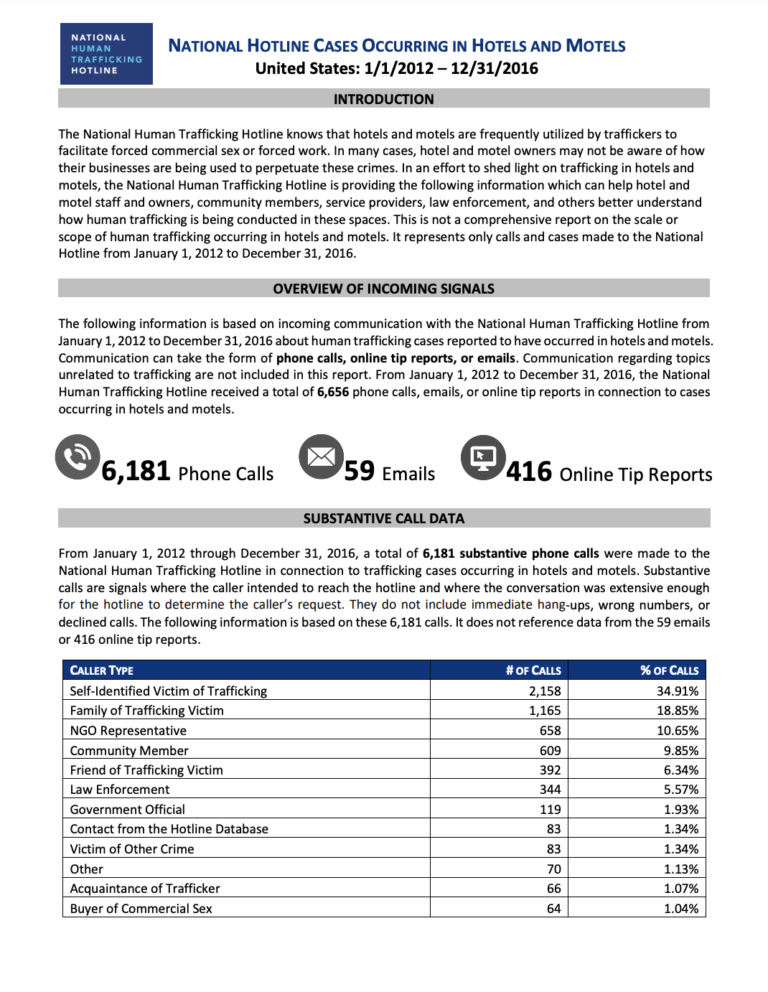
The National Human Trafficking Hotline knows that hotels and motels are frequently utilized by traffickers to facilitate forced commercial sex or forced work. In many cases, hotel and motel owners may not be aware of how their businesses are being used to perpetuate these crimes. In an effort to shed light on trafficking in hotels and motels, the National Human Trafficking Hotline is providing the following information which can help hotel and motel staff and owners, community members, service providers, law enforcement, and others better understand how human trafficking is being conducted in these spaces. This is not a comprehensive report on the scale or scope of human trafficking occurring in hotels and motels. It represents only calls and cases made to the National Hotline from January 1, 2012 to December 31, 2016.

National Hotline Cases Occurring in Hotels and Motels - National Human Trafficking Hotline, 2018 DOWNLOAD

post

page

attachment

revision

nav_menu_item

custom_css

customize_changeset

oembed_cache

user_request

wp_block

wp_template

wp_template_part

wp_global_styles

wp_navigation

wp_font_family

wp_font_face

acf-taxonomy

acf-post-type

acf-field-group

acf-field

ai1ec_event

exactmetrics_note

Guardianship for Children Deprived of Parental Care: A Handbook to Reinforce Guardianship Systems to Cater for the Specific Needs of Child Victims of Trafficking
Guidance

The research looks at how existing systems respond to the particular needs and vulnerabilities of presumed or identified child victims, or children at risk of trafficking and exploitation, such as unaccompanied children. This comparative report help...Read More

TAGS:
Fashioning a beautiful future? Supporting workers and addressing labour exploitation in Leicester’s textile and garment industry
Guidance

This report presents the results of a four-month research study into systemic and locality based factors underpinning labour exploitation within Leicester’s Garment and Textile industry, with particular emphasis on the perspective of frontline wor...Read More

Twenty Years After the Passage of the Palermo Protocol: Identifying Common Flaws in Defining Trafficking through the First Global Study of Domestic Anti-Trafficking Laws
Publications

On November 15, 2000, the United Nations adopted the Protocol to Prevent, Suppress and Punish Trafficking in Persons, Especially Women and Children (Palermo Protocol). Twenty years later, with 178 state parties, the Palermo Protocol has reached almo...Read More

TAGS: Global
Agents for change. How public procurers can influence labour conditions in global supply chains. Case studies from Brazil, Pakistan and Thailand
Publications

The report focuses on the social aspects of supply chains and examines how contracting authorities in the EU can use social criteria to improve labour conditions in countries where poor labour standards are rife. The report draws on experiences an...Read More