
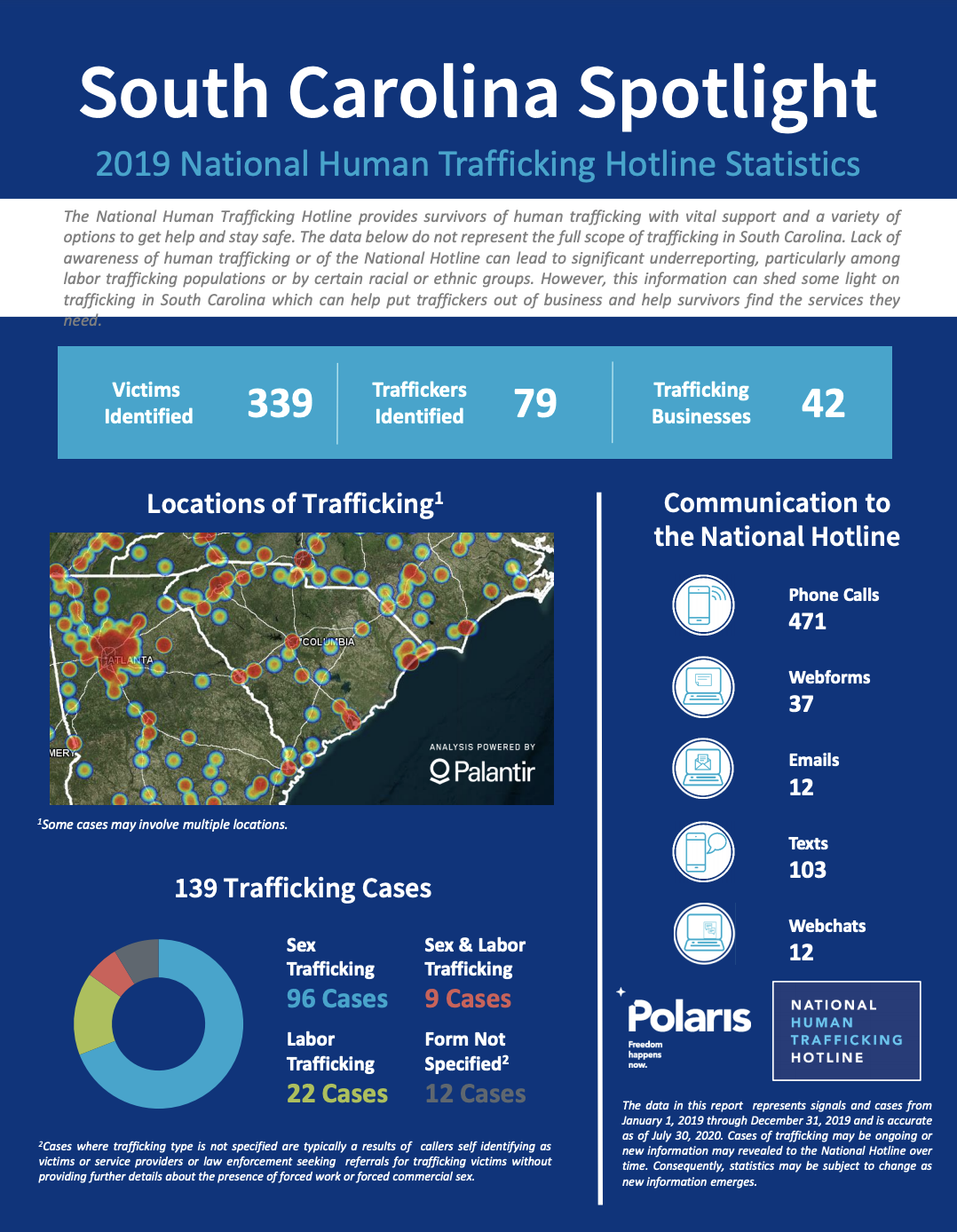
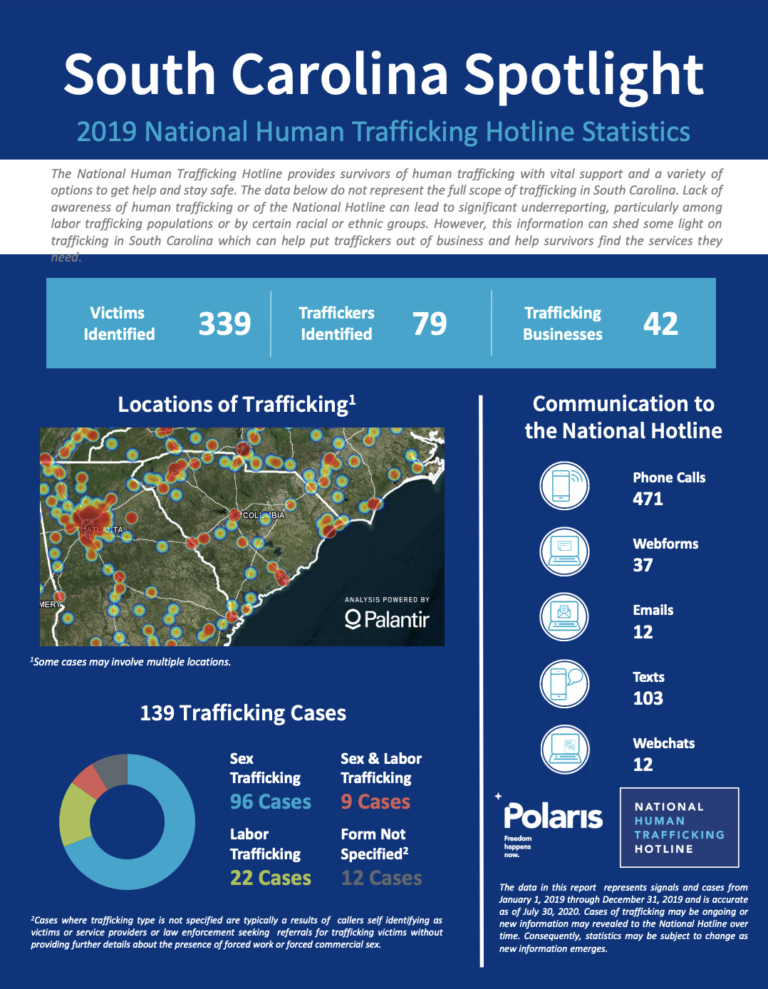
The data in this report represents signals and cases from January 1, 2019 through December 31, 2019 and is accurate as of July 30, 2020. Cases of trafficking may be ongoing or new information may revealed to the National Hotline over time. Consequently, statistics may be subject to change as new information emerges.

You can download the report infographic below.

National Hotline 2019 South Carolina State Report - National Human Trafficking Hotline, 2020 DOWNLOAD

post

page

attachment

revision

nav_menu_item

custom_css

customize_changeset

oembed_cache

user_request

wp_block

wp_template

wp_template_part

wp_global_styles

wp_navigation

wp_font_family

wp_font_face

acf-taxonomy

acf-post-type

acf-field-group

acf-field

ai1ec_event

exactmetrics_note

Twenty Years After the Passage of the Palermo Protocol: Identifying Common Flaws in Defining Trafficking through the First Global Study of Domestic Anti-Trafficking Laws
Publications

On November 15, 2000, the United Nations adopted the Protocol to Prevent, Suppress and Punish Trafficking in Persons, Especially Women and Children (Palermo Protocol). Twenty years later, with 178 state parties, the Palermo Protocol has reached almo...Read More

TAGS: Global
Child labour in the fish supply chain on Lake Volta, Ghana: The Torkor model
Publications

This report illustrates an ILO project in Ghana, in which ILO partnered with the General Agricultural Workers’ Union (GAWU) of Ghana and the Inland Canoe Fishers’ Association to combat child labour throughout the fish supply chain. ...Read More

Leaning In: Advancing the Role of Finance Against Modern Slavery
Publications

This report on modern slavery and financial institutions by the Royal United Services Institute for Defence and Security Studies and the Freedom Fund considers the role that the financial sector can play in reducing human trafficking and modern slave...Read More

List of Goods Produced by Child Labor or Forced Labor – The 2016 List in Numbers
Graphics & Infographics

The U.S. Department of Labor's Bureau Of International Labor Affairs (ILAB) maintains a list of goods and their source countries which it has reason to believe are produced by child labour or forced labour in violation of international standards, as ...Read More