
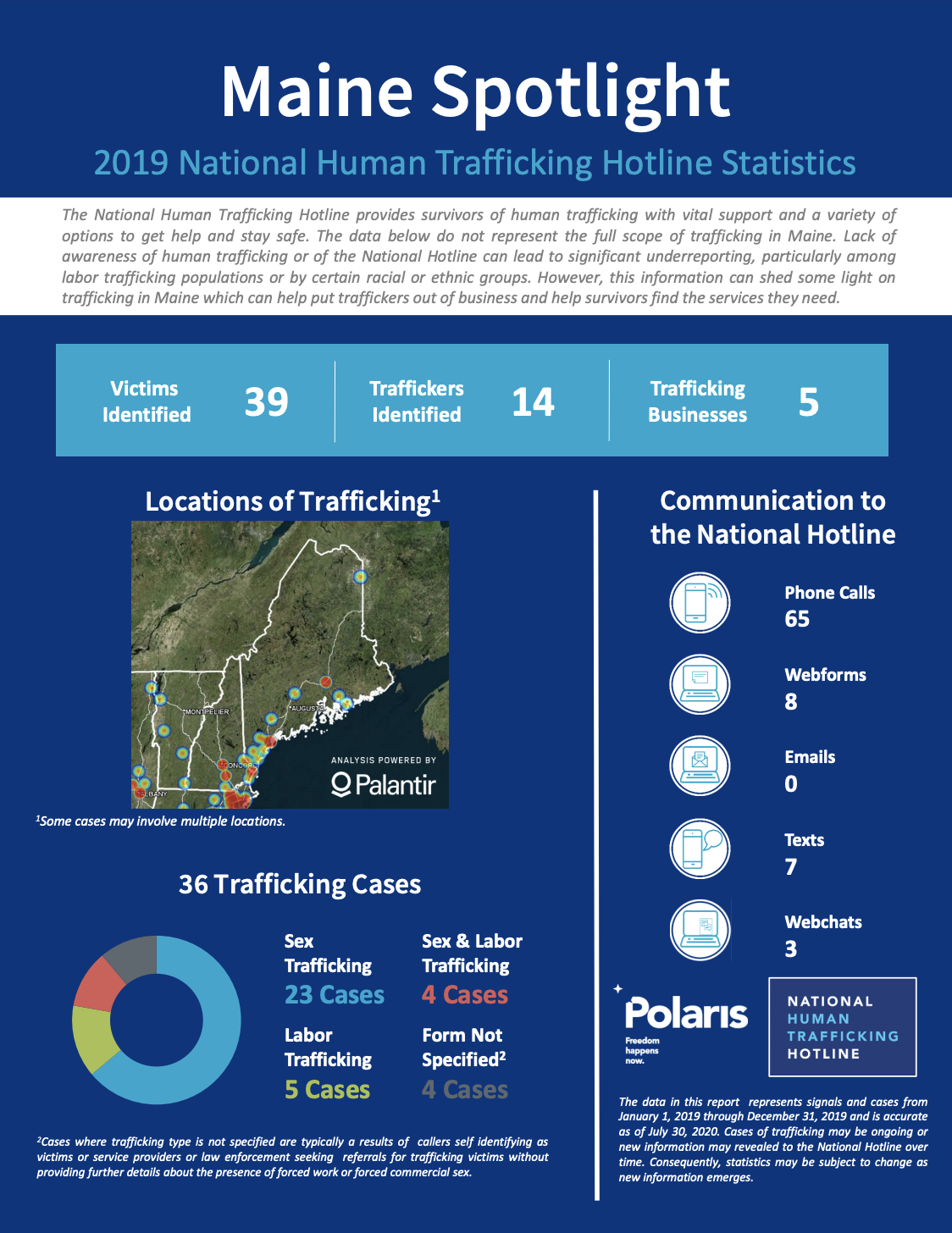
The data in this report represents signals and cases from January 1, 2019 through December 31, 2019 and is accurate as of July 30, 2020. Cases of trafficking may be ongoing or new information may revealed to the National Hotline over time. Consequently, statistics may be subject to change as new information emerges.

You can download the report infographic below.

National Hotline 2019 Maine State Report - National Human Trafficking Hotline, 2020 DOWNLOAD

post

page

attachment

revision

nav_menu_item

custom_css

customize_changeset

oembed_cache

user_request

wp_block

wp_template

wp_template_part

wp_global_styles

wp_navigation

wp_font_family

wp_font_face

acf-taxonomy

acf-post-type

acf-field-group

acf-field

ai1ec_event

exactmetrics_note

The International Legal Definition of Trafficking in Persons: Consolidation of research findings and reflection on issues raised
Publications

Until December 2000, the term “trafficking in persons” was not defined in international law, despite its incorporation in several international legal instruments.The long-standing failure to develop an agreed-upon definition of trafficking in pe...Read More

TAGS:
Global Labour Recruitment in a Supply Chain Context
Publications

The paper is the result of a yearlong inquiry into possible courses of action that would ad- dress the recruitment governance gap, with particular attention to the abuses that affect a large number of workers. It touches only lightly on problems with...Read More

Combating Cyber Violence against Women and Girls
Publications

Digital platforms have often been celebrated for allowing equal opportunities for public self-expression, regardless of one’s identity and status. Yet, not everyone is welcome in the cyberspace. The digital arena has become a breeding ground fo...Read More

TAGS:
Fishing For Data
Publications

Marine fisheries are critical resources for coastal developing countries. They are also difficult to manage sustainably. Almost a third of global fish stocks are degraded from overfishing, and a further 60% are ‘fully exploited’ (FAO, 2016). Ille...Read More