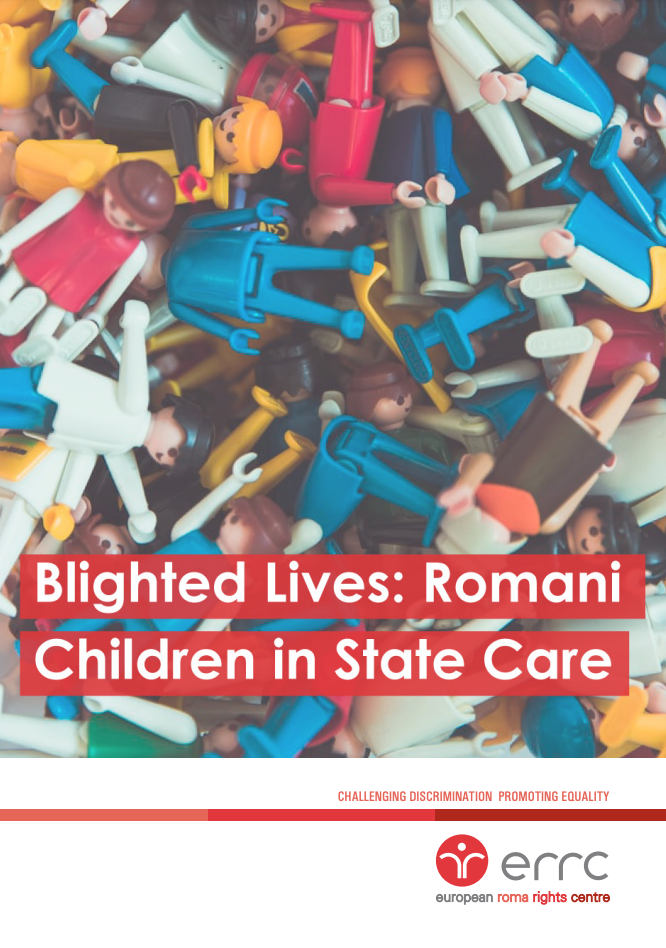
This five-country wide round of research into the situation of Romani children in state care marks the latest in a decade-long series of interventions by the European Roma Rights Centre.13 The research covers four EU Member States: Bulgaria, the Czech Republic, Romania, and Slovakia, as well as neighbouring Moldova. As was mentioned in the introduction, the plight of these most vulnerable children, and the issue of their fundamental rights and wellbeing, did not register as a priority when the EU Framework for National Roma Integration Strategies was launched in 2011.

The publication of this research followed the launch of the European Commission’s EU Roma strategic framework for equality, inclusion and participation for 2020–2030. It also coincided with the finding by the European Committee of Social Rights (ECSR) in November 2020, that holds the Czech Republic responsible for large-scale and discriminatory placement of children with disabilities and Romani children in early childhood care institutions.

Blighted Lives - Romani Children in State Care - European Roma Rights Centre, 2021 DOWNLOAD

post

page

attachment

revision

nav_menu_item

custom_css

customize_changeset

oembed_cache

user_request

wp_block

wp_template

wp_template_part

wp_global_styles

wp_navigation

wp_font_family

wp_font_face

acf-taxonomy

acf-post-type

acf-field-group

acf-field

ai1ec_event

exactmetrics_note

The role of social protection in the elimination of child labour: Evidence review and policy implications
Guidance

At the beginning of 2020 1 in 10 children aged 5 and over were involved in child labour worldwide – equating to an estimated 160 million children, or 63 million girls and 97 million boys. Despite significant progress in reducing child labour in th...Read More

Addressing forced labor and other modern slavery risks: A toolkit for corporate suppliers
Guidance

This toolkit aims to help companies that work in corporate supply chains to quickly identify areas of their business which carry the highest risk of modern slavery and develop a simple plan to prevent and address any identified risks. It is designed...Read More

General Principles and Operational Guidelines for Fair Recruitment- Definition of Recruitment Fees and Related Costs
Guidance

The objective of these non-binding ILO general principles and operational guidelines for fair recruitment (hereafter “principles and guidelines”) is to inform the current and future work of the ILO and of other organizations, national legislatur...Read More

Freedom Business Code of Excellence 2.0
Guidance

Today over 40 million people are enslaved worldwide. 80% of those rescued from modern slavery, also known as Human Trafficking, will be re-trafficked absent safe employment opportunities. To fight modern slavery and exploitation we need a strategy t...Read More

TAGS: