Since 2011, the Asian Development Bank Institute (ADBI), the OECD, and the International Labour Organization (ILO) have been collaborating to organize the Annual Roundtable on Labor Migration in Asia. The 10th anniversary of this event was marked in February 2020 in Bangkok, on the theme “Labor Migration in Asia: Future of Labor Migration in Asia – Challenges and Opportunities in the Next Decade.”

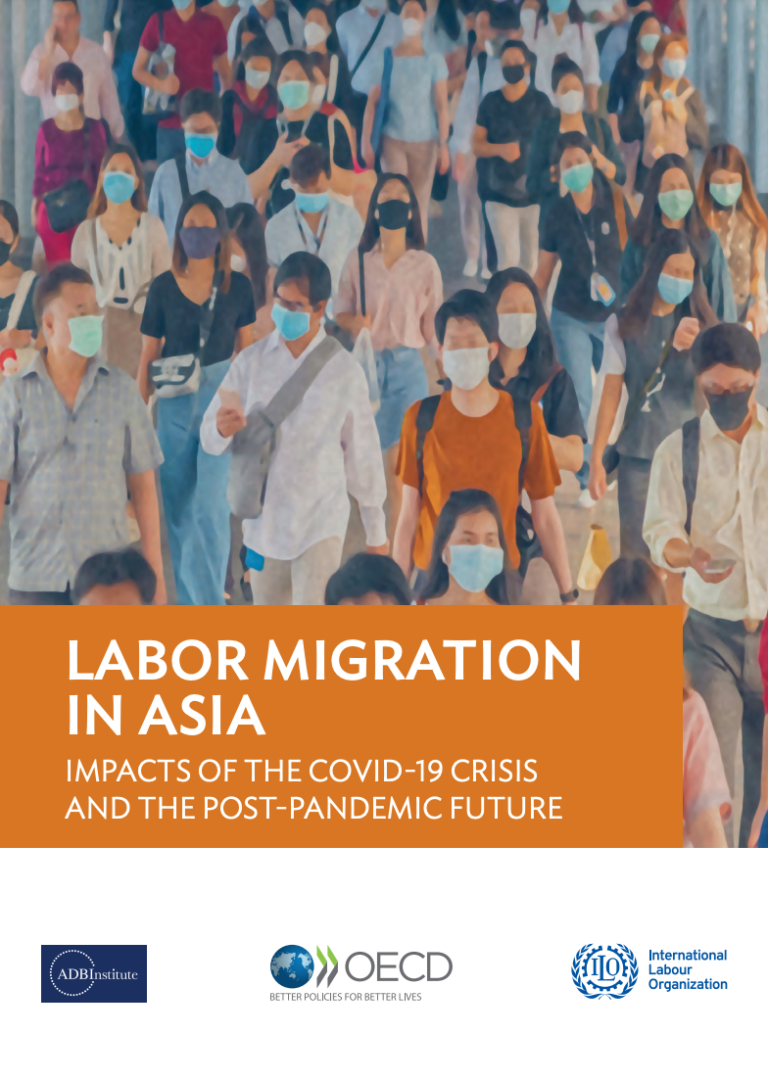
ADBI, OECD, and ILO have also prepared this joint publication. The 2021 edition, “Impacts of the COVID-19 Crisis and the Post-Pandemic Future,” has three chapters and a statistical annex providing the most complete comparative data on international labor mobility in Asia. The joint publication includes the major outcomes from the 10th Roundtable on Labor Migration in Asia. This 2021 publication has also pivoted to look at trends and the future of labor migration in light of the disruptions and developments related to the COVID-19 pandemic.

The current economic and social transitions in the global economy, as well as the unprecedented COVID-19 pandemic, have sharply affected labor migration in Asia and put pressure on policy makers and regulators to develop timely policy responses and innovative approaches for guaranteeing the effective management of labor migration. We hope that this publication will provide useful policy guidance and statistical reference to practitioners, authorities, and policy makers. Further, we extend our sincere gratitude to the organizing team for their efforts and contribution in preparing this joint publication and the Annual Roundtable on Labor Migration in Asia.

Labor Migration in Asia: Impacts of the COVID-19 Crisis and the Post-Pandemic Future - Organisation for Economic Co-operation and Development, 2021 DOWNLOAD

post

page

attachment

revision

nav_menu_item

custom_css

customize_changeset

oembed_cache

user_request

wp_block

wp_template

wp_template_part

wp_global_styles

wp_navigation

wp_font_family

wp_font_face

acf-taxonomy

acf-post-type

acf-field-group

acf-field

ai1ec_event

exactmetrics_note

ILO indicators of forced labour
Guidance

This booklet presents an introduction to the ILO Indicators of Forced Labour. These indicators are intended to help “front-line” criminal law enforcement officials, labour inspectors, trade union officers, NGO workers and others to identify pers...Read More

Prevalence Estimate: Forced Labor Among Kenyan Workers in the Gulf Cooperation Council
Guidance

The Global Fund to End Modern Slavery (GFEMS) aims to end modern slavery by making it economically unprofitable through interventions and experimental innovations implemented in collaboration with on-the-ground partners. With support from the U.S. D...Read More

Communication from the Commission to the European Parliament, The Council, and The European Economic and Social Committee: On decent work worldwide for a global just transition and a sustainable recovery
Guidance

According to the latest global estimates, 160 million children worldwide are in child labour. That is one in ten children in the world, and their number is growing. Nearly half of these children are performing hazardous work. At the same time, 25 mi...Read More

Detecting and Stopping Forced Sexual Servitude in Australia: Financial Crime Guide
Guidance

The Fintel Alliance has developed this financial crime guide to help financial services businesses understand and identify the signs of forced sexual servitude in Australia. The indicators and behaviours in this financial crime guide can be used by ...Read More