
The Office of Child Labor, Forced Labor, and Human Trafficking (OCFT) in the Bureau of International Labor Affairs (ILAB) within U.S. Department of Labor (USDOL) has invested in programs over the last 25 years to eliminate child labor and forced labor. To guide future investments in these areas, OCFT emphasizes monitoring and evaluating the performance of its current and past programs, identifying challenges and best practices, and communicating key findings and effective and sustainable strategies to stakeholders.

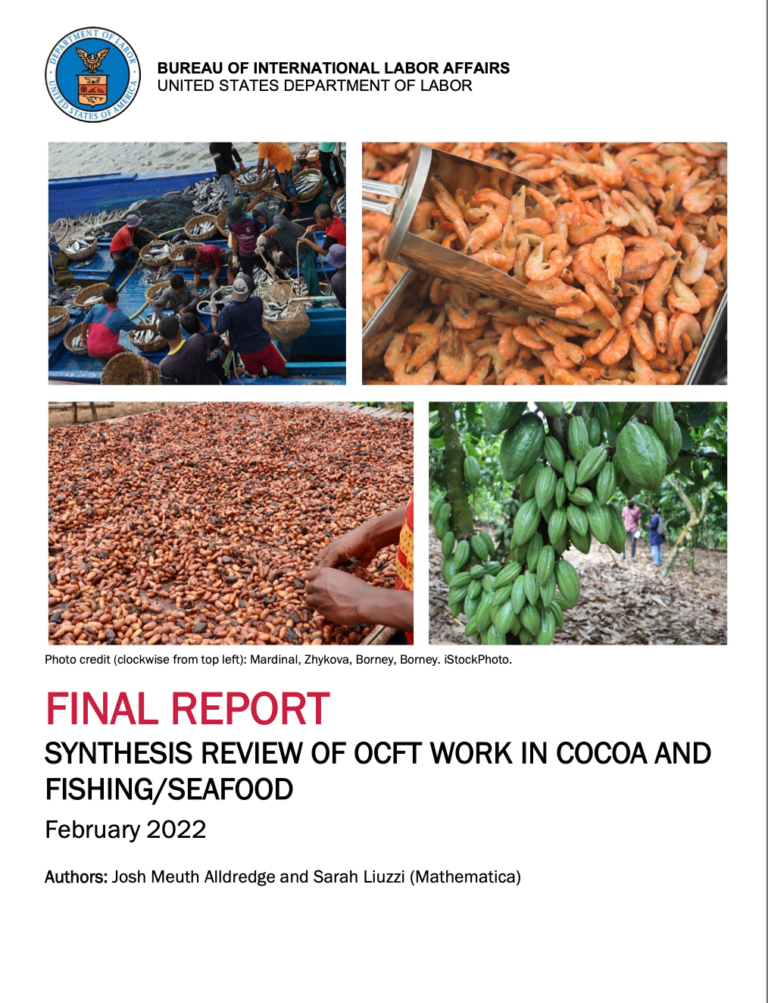
To learn more from its programming, OCFT commissioned a study to synthesize findings from performance evaluations and monitoring data from 19 ILAB-funded projects implemented from 1999 through 2021 to reduce child labor and/or forced labor in the cocoa and fishing/seafood sectors.

Synthesis Review of OCFT Work in Cocoa and Fishing/Seafood - Josh Meuth Alldredge and Sarah Liuzzi (Mathematica), US Department of Labor, February 2022 DOWNLOAD

post

page

attachment

revision

nav_menu_item

custom_css

customize_changeset

oembed_cache

user_request

wp_block

wp_template

wp_template_part

wp_global_styles

wp_navigation

wp_font_family

wp_font_face

acf-taxonomy

acf-post-type

acf-field-group

acf-field

ai1ec_event

exactmetrics_note

Scaling Impact: Tech Against Trafficking Launches Accelerator Program
News & Analysis

By: Hannah Darnton, Business for Social Responsibility There are few facets of modern life that are untouched by technology. Innovations in the industry have changed the way we communicate, the way we work, the way we conduct commerce, and the wa...Read More

Letting exploitation off the hook? Evidencing labour abuses in UK fishing
News & Analysis

Year-on-year, the number of migrant fishers crewing United Kingdom-flagged fishing vessels is seemingly increasing. Primarily from European states, the Philippines, and Ghana with fewer numbers of fishers from Indonesia, India, and Sri Lanka, there ...Read More

The Link between Extractive Industries and Sex Trafficking
News & Analysis

Extractive industries involve the removal of non-renewable raw materials such as oil, gas, metals, and minerals from the earth. Although communities can benefit from such industries by using these natural resources for sustainable development, their...Read More

Malawi’s Human-Trafficking Routes: Mapping Cross-Boarder Transit Points Using Collective Data
News & AnalysisGuidance

The existence of our group, the Malawi Network Against Trafficking, is testament to the high level of collaboration and support that already exists within the anti-trafficking sphere in Malawi. We are very lucky to have a community that spans nearly...Read More