
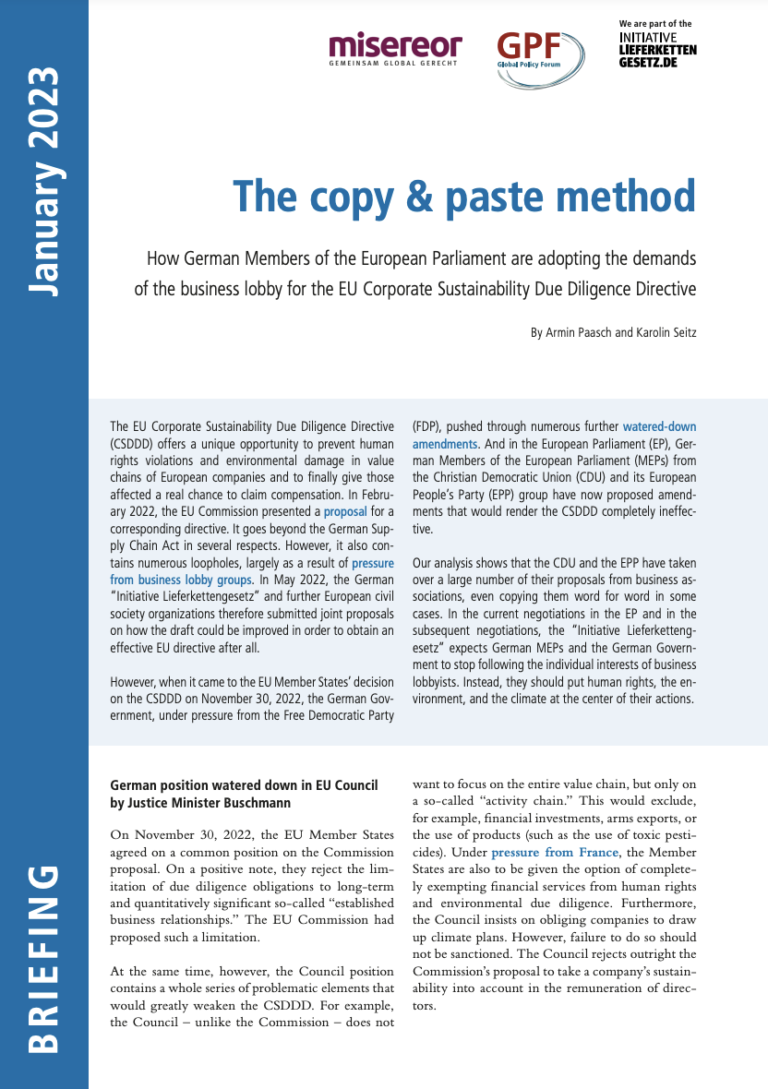
The EU Corporate Sustainability Due Diligence Directive (CSDDD) offers a unique opportunity to prevent human rights violations and environmental damage in value chains of European companies and to finally give those affected a real chance to claim compensation. In February 2022, the EU Commission presented a proposal for a corresponding directive. It goes beyond the German Supply Chain Act in several respects. However, it also contains numerous loopholes, largely as a result of pressure from business lobby groups. In May 2022, the German “Initiative Lieferkettengesetz” and further European civil society organizations therefore submitted joint proposals on how the draft could be improved in order to obtain an effective EU directive after all.

The copy & paste method: How German Members of the European Parliament are adopting the demands of the business lobby for the EU Corporate Sustainability Due Diligence Directive - Global Policy Forum, 2023 DOWNLOAD

post

page

attachment

revision

nav_menu_item

custom_css

customize_changeset

oembed_cache

user_request

wp_block

wp_template

wp_template_part

wp_global_styles

wp_navigation

wp_font_family

wp_font_face

acf-taxonomy

acf-post-type

acf-field-group

acf-field

ai1ec_event

exactmetrics_note

Updated Modern Slavery Map
News & AnalysisOnline Tools

We have updated our Interactive Map for Business of Anti-Human Trafficking Organisations (www.modernslaverymap.org). The Map currently includes 112 initiatives and organisations who are working on five human-trafficking-related issues (child labour,...Read More

Inside job: How business lobbyists used the Commission’s scrutiny procedures to weaken human rights and environmental legislation
News & Analysis

A proposed EU law that seeks to hold companies accountable for human rights abuses, climate change, and environmental destruction has been severely watered down by corporate lobbyists, with assistance from the European Commission’s own business-fr...Read More

The Link between Extractive Industries and Sex Trafficking
News & Analysis

Extractive industries involve the removal of non-renewable raw materials such as oil, gas, metals, and minerals from the earth. Although communities can benefit from such industries by using these natural resources for sustainable development, their...Read More

Heavy Rare Earths Supply Chain Risks: Illicit Minerals from Myanmar are the World’s Largest Source of Supply
News & Analysis

The global economy is becoming increasingly reliant upon rare earth minerals, the ores of 17 metallic elements that are a key part of renewable energy solutions to climate change, enabling us to reduce our reliance on fossil fuels. Two of these ...Read More

TAGS: Global