
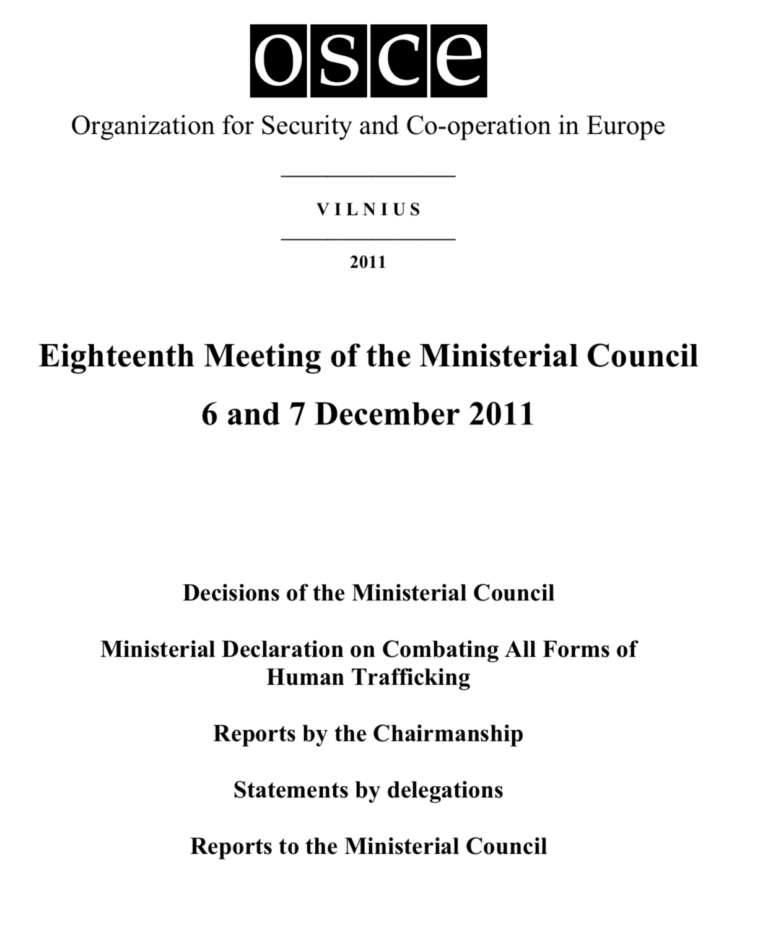
The declaration encourage OSCE participating States to work with the business sector to apply principles of due diligence and transparency in assessing and addressing risks of exploitation throughout supply chains and ensuring that workers have access to mechanisms to redress and remedy abusive practices. It also encourages the dissemination and implementation of the United Nations Guiding Principles on Business and Human Rights. Similarly, the declaration encourages governments to consider incorporating similar standards, including “zero-tolerance” policies, in government procurement of goods and services.

Ministerial Declaration on Combating All Forms of Human Trafficking - Organization for Security and Co-operation in Europe, 2011 DOWNLOAD

post

page

attachment

revision

nav_menu_item

custom_css

customize_changeset

oembed_cache

user_request

wp_block

wp_template

wp_template_part

wp_global_styles

wp_navigation

wp_font_family

wp_font_face

acf-taxonomy

acf-post-type

acf-field-group

acf-field

ai1ec_event

exactmetrics_note

National Hotline 2019 West Virginia State Report
Graphics & InfographicsPublications

The data in this report represents signals and cases from January 1, 2019 through December 31, 2019 and is accurate as of July 30, 2020. Cases of trafficking may be ongoing or new information may revealed to the National Hotline over time. Consequen...Read More

Popular and Political Representations
Publications

Edited by Joel Quirk and Julia O’Connell Davidson. This is the first volume of the series Beyond Trafficking and Slavery Short Course. Much of what people think they know about human trafficking and ‘modern-day slavery’ is inaccurate, ...Read More

Current and Potential Impacts of Legal Reforms on Businesses and Workers in Thailand’s Fishing Industry
Publications

While some challenges around design and implementation remain, the aim of the reforms- to improve conditions for workers in the sector, help to restore Thailand's depleted fish stocks and ultimately to make the industry more safe, sustainable and pr...Read More

Impact of the CARE Tipping Point Program in Nepal on adolescent girls’ agency and risk of child, early, or forced marriage: Results from a cluster-randomized controlled trial
Publications

ackground: Girl child, early, and forced marriage (CEFM) persists in South Asia, with long-term effects on well- being. CARE’s Tipping Point Initiative (TPI) sought to address the gender norms and inequalities underlying CEFM by engaging part...Read More

TAGS: