
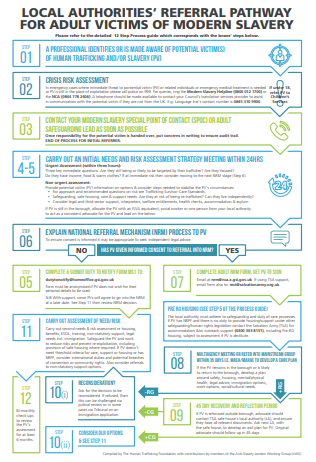
Together with the London Working Group, the Human Trafficking Foundation has produced the Referral pathway for adult victims to help Local Authorities improve their response to human trafficking and modern slavery, in particular the identification and support offered to adult survivors.

Local Authorities' Referral Pathway for Adult Victims of Modern Slavery - Human Trafficking Foundation, 2018 DOWNLOAD

post

page

attachment

revision

nav_menu_item

custom_css

customize_changeset

oembed_cache

user_request

wp_block

wp_template

wp_template_part

wp_global_styles

wp_navigation

wp_font_family

wp_font_face

acf-taxonomy

acf-post-type

acf-field-group

acf-field

ai1ec_event

exactmetrics_note

Potential for Legal Liabilities and Claims for Unpaid Wages in the Palm Oil Industry
Guidance

To support the further knowledge and understanding of the relationship between palm oil industry stakeholders (the “Industry”) and the communities that supply workers and the potential risks that may arise to these stakeholders and also those wi...Read More

Towards safer recruitment of Ethiopian women into domestic work abroad: Early findings from the Meneschachin ‘Our Departure’ qualitative study
Guidance

This report presents preliminary findings from the first phase of data collection of the Meneshachin ‘Our Departure’ qualitative study (August 2020-May 2021) conducted by the London School of Hygiene and Tropical Medicine (LSHTM) in collabo...Read More

National Hotline 2017 Nevada State Report
Graphics & InfographicsPublications

The data in this report represents signals and cases from January 1, 2017 through December 31, 2017 and is accurate as of July 11, 2018. Cases of trafficking may be ongoing or new information may be revealed to the National Hotline over time. Conseq...Read More

Disrupting harm in Tanzania: Evidence on online child sexual exploitation and abuse
Guidance

Our online lives are advancing constantly. The internet and rapidly evolving digital communication tools are bringing people everywhere closer together. Children are increasingly conversant with and dependent on these technologies, and the COVID-19 ...Read More