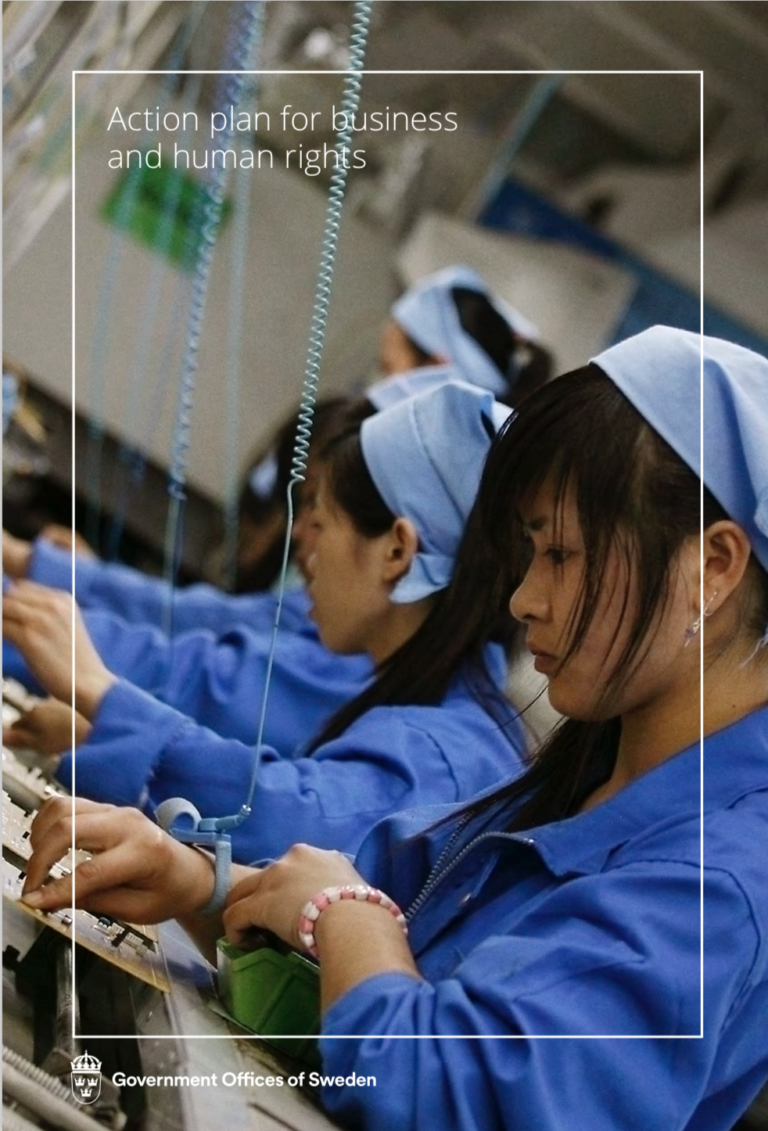
The national action plan aims to translate the UN Guiding Principles into practical action at national level. The plan responds to the European Commission’s request that Member States draw up national action plans. So far, the UK, the Netherlands, Denmark, Finland and Lithuania have developed national action plans.

Business enterprises appear to have a greater awareness of their responsibility to respect human rights and of the role this plays in creating value and building business competi- tiveness. The Government’s ambition is to assist enterprises in their efforts in this area.

A clear Swedish profile in this area can contribute to strengthening Sweden as a brand. The Guiding Principles are also fundamental to the corporate governance of state-owned enterprises.

The action plan is also an important part of the Government’s heightened ambitions for foreign trade, through the export strategy, CSR and other areas. It is an equally important part of the Government’s relaunch of its Policy for Global Development and its efforts to contribute to the new global sustainable development goals (SDGs).

Action plan for business and human rights - The Swedish Ministry of Foreign Affairs, 2015 DOWNLOAD

post

page

attachment

revision

nav_menu_item

custom_css

customize_changeset

oembed_cache

user_request

wp_block

wp_template

wp_template_part

wp_global_styles

wp_navigation

wp_font_family

wp_font_face

acf-taxonomy

acf-post-type

acf-field-group

acf-field

ai1ec_event

exactmetrics_note

Special Issue – Anti-Trafficking Education
GuidancePublications

The past decade has seen a dramatic increase in the sites for anti-trafficking education and the range of educators who shape how the public and institutions understand and respond to human trafficking. The aim of this Special Issue of Anti-Traff...Read More

First Year of FTSE 100 Reports under the UK Modern Slavery Act: Towards Elimination?
Publications

The International Labour Organization estimates that illicit profits from modern slavery reach $150 billion a year. In 2016, 16 million people were victims of forced labour in the private economy. Companies are exposed to modern slavery risks through...Read More

Supporting Bright Futures – Young Women and Girls and Labour Migration in South-East Asia and the Pacific
Publications

At first glance, this research publication may seem niche, perhaps relevant only to “fringe” aspects of international migration. Historically, we know from decades of studies, data collection and analysis that there has been a strong bias toward...Read More

Twenty Years After the Passage of the Palermo Protocol: Identifying Common Flaws in Defining Trafficking through the First Global Study of Domestic Anti-Trafficking Laws
Publications

On November 15, 2000, the United Nations adopted the Protocol to Prevent, Suppress and Punish Trafficking in Persons, Especially Women and Children (Palermo Protocol). Twenty years later, with 178 state parties, the Palermo Protocol has reached almo...Read More

TAGS: Global