
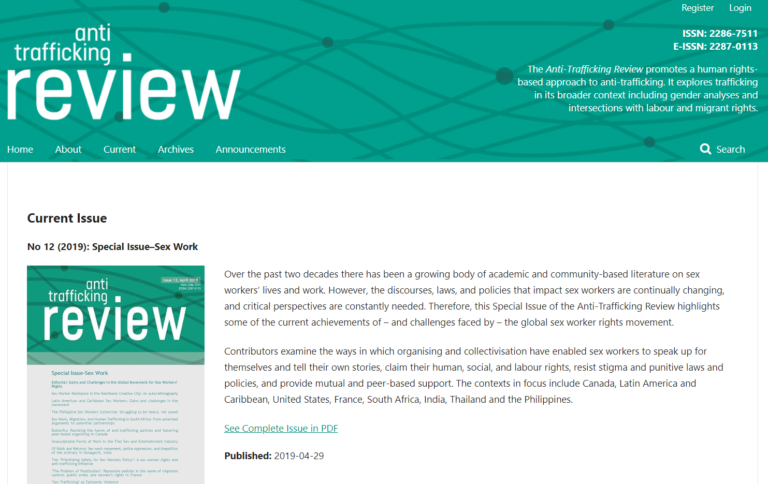
The Anti-Trafficking Review promotes a human rights-based approach to anti-trafficking. It explores trafficking in its broader context including gender analyses and intersections with labour and migration. It offers an outlet and space for dialogue between academics, practitioners, trafficked persons and advocates seeking to communicate new ideas and findings to those working for and with trafficked persons.

Anti-Trafficking Review: Special Issue–Sex Work - Global Alliance Against Trafficking in Women, 2019 DOWNLOAD

post

page

attachment

revision

nav_menu_item

custom_css

customize_changeset

oembed_cache

user_request

wp_block

wp_template

wp_template_part

wp_global_styles

wp_navigation

wp_font_family

wp_font_face

acf-taxonomy

acf-post-type

acf-field-group

acf-field

ai1ec_event

exactmetrics_note

Twenty Years After the Passage of the Palermo Protocol: Identifying Common Flaws in Defining Trafficking through the First Global Study of Domestic Anti-Trafficking Laws
Publications

On November 15, 2000, the United Nations adopted the Protocol to Prevent, Suppress and Punish Trafficking in Persons, Especially Women and Children (Palermo Protocol). Twenty years later, with 178 state parties, the Palermo Protocol has reached almo...Read More

TAGS: Global
The Prevalence of Domestic Servitude among Child Domestic Workers in Addis Ababa, Ethiopia: Research Findings
News & AnalysisPublications

It is estimated that there are 17.2 million child domestic workers globally, most of whom are girls (International Labor Organization (ILO), 2013; ILO, n.d.). Despite their large numbers, research related to this marginalised group is extremely limi...Read More

Teens of Tobacco Fields
Publications

In July 2015, Human Rights Watch interviewed 26 children, ages 16 and 17, who worked on tobacco farms in North Carolina that summer. Almost all of the children inter- viewed—25 out of 26—said they experienced sickness, pain, and discomfort while...Read More

Ministerial Declaration on Combating All Forms of Human Trafficking
Publications

The declaration encourage OSCE participating States to work with the business sector to apply principles of due diligence and transparency in assessing and addressing risks of exploitation throughout supply chains and ensuring that workers have acces...Read More