
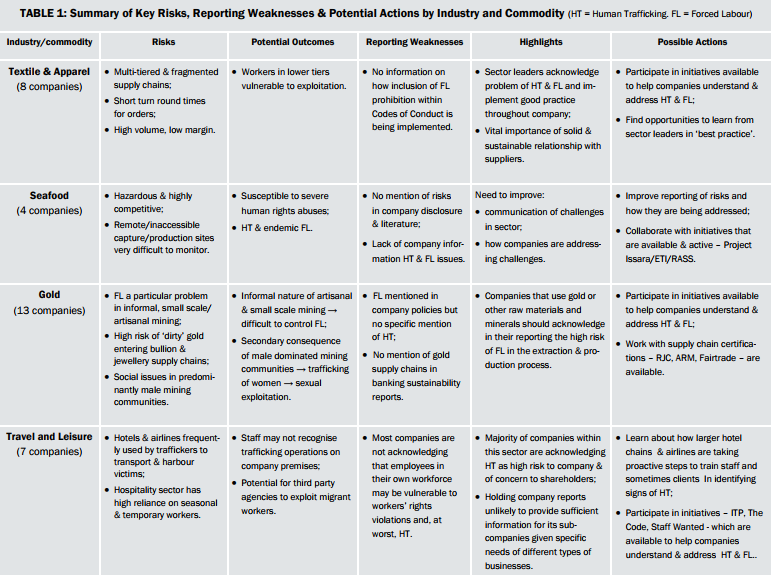
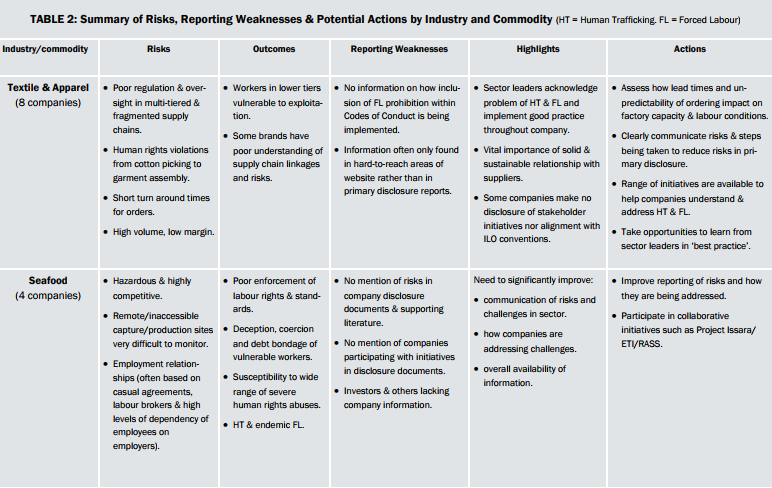
As shareholders of a company, investors have the power and incentive to influence company behaviours, and can have considerable influence over the way in which a company addresses and mitigates its risks in the area of human trafficking and forced labour. This report provides investors with a selection of representative industry examples and case studies that will enable them to be more conversant with, and have greater understanding of, the nature of human trafficking and forced labour risks in various sectors. Advice and guidance is given to investors and businesses on how these risks can be addressed and companies can meet their corporate responsibilities.

Forced Labour, Human Trafficking and the FTSE 100 - A Review of Company Disclosure and Recommendations for Investor Engagement - Finance Against Trafficking, 2015 DOWNLOAD

post

page

attachment

revision

nav_menu_item

custom_css

customize_changeset

oembed_cache

user_request

wp_block

wp_template

wp_template_part

wp_global_styles

wp_navigation

wp_font_family

wp_font_face

acf-taxonomy

acf-post-type

acf-field-group

acf-field

ai1ec_event

exactmetrics_note

Corporate Social Responsibility Review: Risks of Child Labor on Select Coffee Farms in Nicaragua
Publications

In Nicaragua, coffee is mainly produced on small-scale farms where temporary or seasonal work, weak remuneration, subcontracting, migrant workers, and child labor are likely to exist. In recent years, corporate social responsibility (CSR) activitie...Read More

The Other Migrant Crisis – Protecting Migrant Workers against Exploitation in the Middle East and North Africa
Publications

The Middle East and North Africa (MENA) region continues to host groups highly vulnerable to trafficking and exploitation. Migrant workers, particularly domestic workers, are known to be among those who are most at risk. While the region is co...Read More

A call for pan-European action to tackle forced labour and child labour in global supply chains
Publications

This briefing for European policy makers outlines the increased risk of forced and child labour, in global supply chains of goods and services. It argues that extant national and EU law and policies are insufficient to eradicate slavery in supply ch...Read More

Role of organized criminal groups with regard to contemporary forms of slavery
Publications

The present report is submitted in accordance with Human Rights Council resolution 42/10. By providing examples from all geographical regions, it assesses the role of organized criminal groups in contemporary forms of slavery. To that end, the profi...Read More

TAGS: Global