
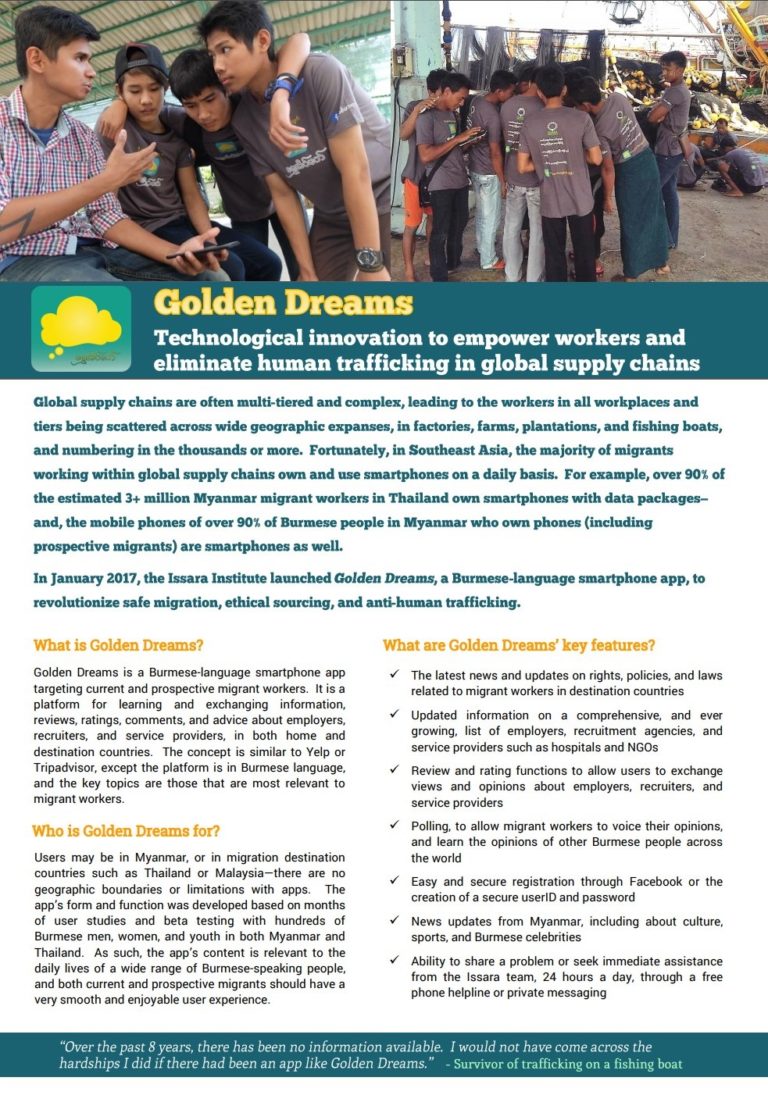
Golden Dreams is a Burmese-language smartphone app targeting current and prospective migrant workers. It is a platform for learning and exchanging information, reviews, ratings, comments, and advice about employers, recruiters, and service providers, in both home and destination countries. The concept is similar to Yelp or Tripadvisor, except the platform is in the Burmese language, and the key topics are those that are most relevant to migrant workers.

Golden Dreams Infosheet- Issara Institute, 2017 DOWNLOAD

post

page

attachment

revision

nav_menu_item

custom_css

customize_changeset

oembed_cache

user_request

wp_block

wp_template

wp_template_part

wp_global_styles

wp_navigation

wp_font_family

wp_font_face

acf-taxonomy

acf-post-type

acf-field-group

acf-field

ai1ec_event

exactmetrics_note

Forced Labour in the Uyghur Region: The Evidence
Publications

The People’s Republic of China (PRC) has instituted an unprecedented system of state-sponsored forced la- bor for Uyghur, Kazakh, Kyrgyz, and other minoritized citizens in the Xinjiang Uyghur Autonomous Region (or XUAR or Uyghur Region, also known...Read More

TAGS:
Forced to beg Child trafficking from Guinea-Bissau to Senegal
GuidancePublications

Taking children from Guinea-Bissau to Senegal and forcing them to beg on the streets has become the most visible form of human trafficking in both countries. Many Quranic teachers and intermediaries’ prey on vulnerable families in Guinea-Bissau. O...Read More

TAGS: Africa
On Thin Ice: Proving What We Know to be True – An Examination of the Nexus Between Human Trafficking and Corruption
Publications

Most in the anti-human trafficking and modern slavery community agree that trafficking activities are aided and facilitated by corruption. Yet research shows that the available data supporting this assumption is thin. More evidence is needed to bette...Read More

TAGS:
Tobacco’s Hidden Children: Hazardous Child Labour in United States Tobacco Farming
Publications

Methodology This report is based on interviews with 141 children ages 7 to 17 who said they had worked in tobacco farming in the United States in 2012 or 2013. During multiple field research trips between May and October 2013, Human Rights Watch ...Read More