
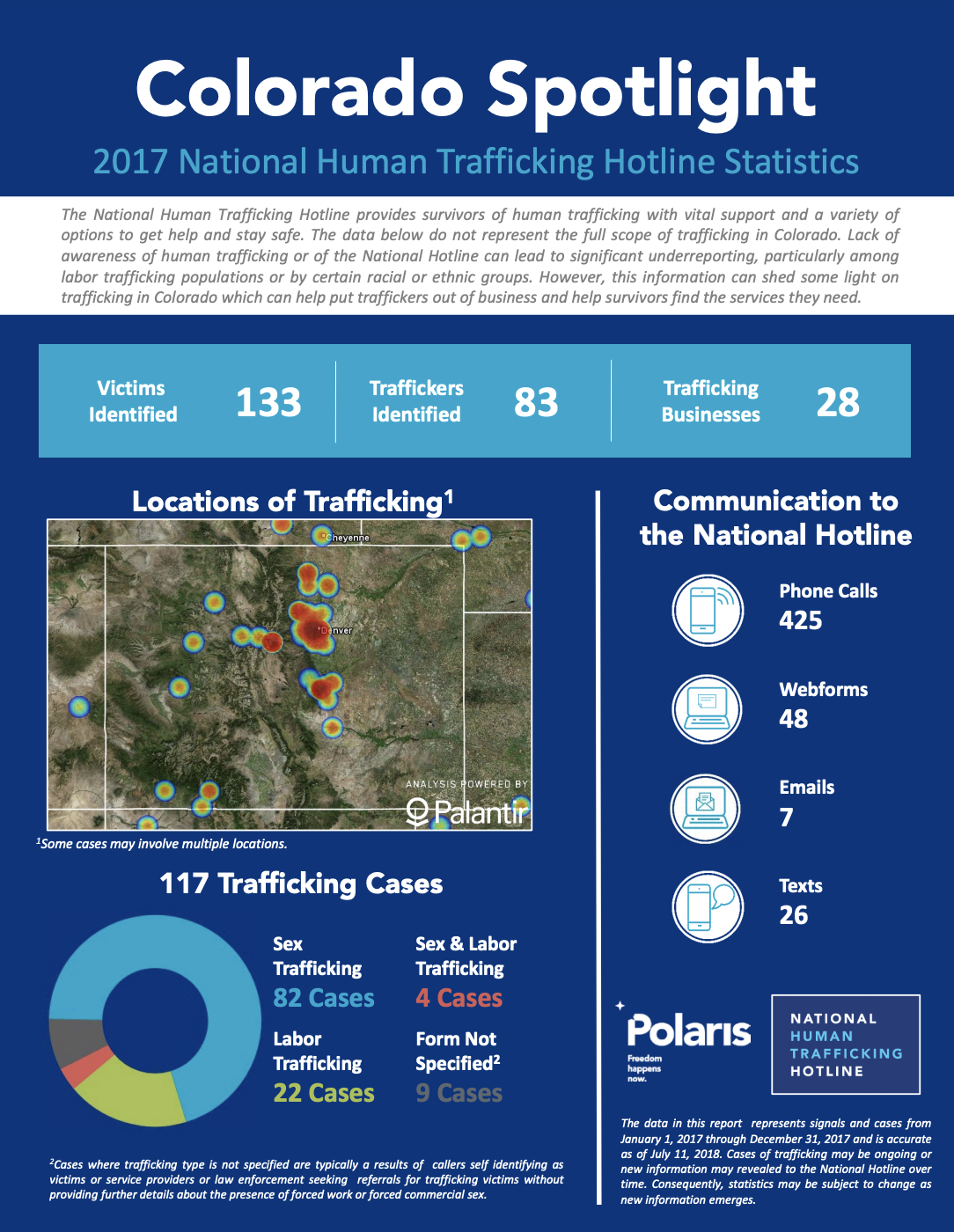
The data in this report represents signals and cases from January 1, 2017 through December 31, 2017 and is accurate as of July 11, 2018. Cases of trafficking may be ongoing or new information may be revealed to the National Hotline over time. Consequently, statistics may be subject to change as new information emerges.

You can download the report infographic below.

National Hotline 2017 Colorado State Report - National Human Trafficking Hotline, 2018 DOWNLOAD

post

page

attachment

revision

nav_menu_item

custom_css

customize_changeset

oembed_cache

user_request

wp_block

wp_template

wp_template_part

wp_global_styles

wp_navigation

wp_font_family

wp_font_face

acf-taxonomy

acf-post-type

acf-field-group

acf-field

ai1ec_event

exactmetrics_note

Trafficking of Human Beings for the Purpose of Organ Removal in North and West Africa
Publications

This report from INTERPOL assesses the problem of trafficking in human beings for organ removal (THBOR), which is driven largely by the global shortage in organs for ethical transplant. While organ trafficking exists in all regions of the world, it ...Read More

Using Civil Litigation to Combat Human Trafficking
LegislationPublications

In October 2003, Congress passed a law allowing trafficking victims to recover civil damages from their traffickers in federal courts, 18 U.S.C. § 1595, now known as the Trafficking Victims Protection Reauthorization Act (TVPRA). In the almost twen...Read More

TAGS:
COVID-19: Access Challenges and the Implications of Border Restrictions
COVID-19 resourcesPublications

The COVID-19 pandemic has required States to implement exceptional measures to curb the spread of the virus and to protect public health. While border restrictions or closure may be justified, exceptions are needed to safeguard basic rights, includi...Read More

Reclaiming Migrant Women’s Narratives: A Feminist Participatory Action Research Project on ‘Safe and Fair’ Migration in Asia
Publications

The report shows that Safe and Fair migration cannot happen in a silo – the factors that produce gender segregated labour markets, industries dependent on flexible, underpaid and overworked migrant labour require a systemic change. This change can...Read More

TAGS: