
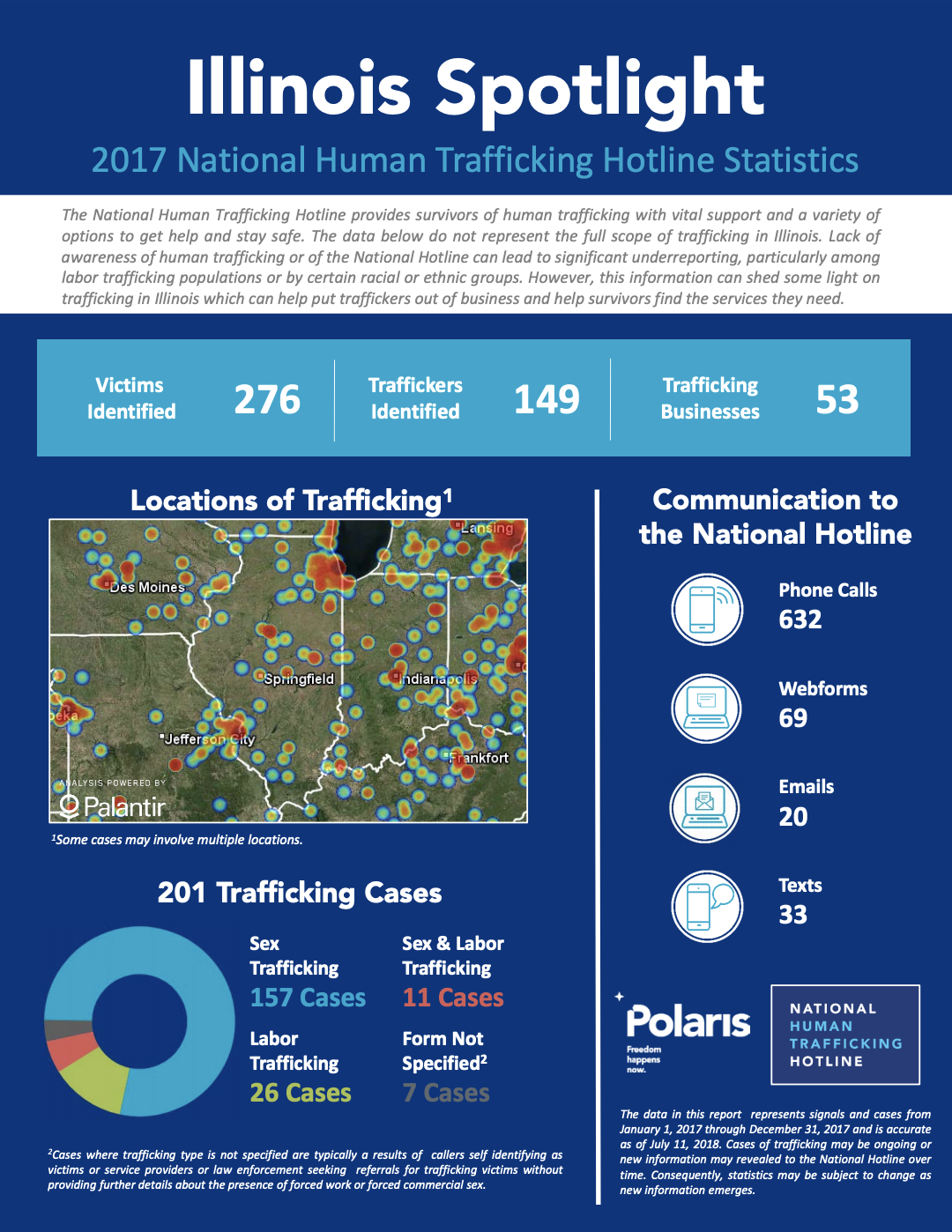
The data in this report represents signals and cases from January 1, 2017 through December 31, 2017 and is accurate as of July 11, 2018. Cases of trafficking may be ongoing or new information may be revealed to the National Hotline over time. Consequently, statistics may be subject to change as new information emerges.

You can download the report infographic below.

National Hotline 2017 Illinois State Report - National Human Trafficking Hotline, 2018 DOWNLOAD

post

page

attachment

revision

nav_menu_item

custom_css

customize_changeset

oembed_cache

user_request

wp_block

wp_template

wp_template_part

wp_global_styles

wp_navigation

wp_font_family

wp_font_face

acf-taxonomy

acf-post-type

acf-field-group

acf-field

ai1ec_event

exactmetrics_note

Race, Ethnicity and Belonging
Publications

Edited by Joel Quirk and Julia O’Connell Davidson. This is the sixth volume of the series Beyond Trafficking and Slavery Short Course. Slavery cannot be reduced to a chapter in history that is now closed, but must instead be regarded as a c...Read More

Survival at the Expense of the Weakest? Managing Modern Slavery Risks in Supply Chains During COVID-19
COVID-19 resourcesPublications

This paper reflects on the implications of the Coronavirus (COVID-19) pandemic on modern slavery risks in supply chains. We first reason that the global supply and demand shock resulting from COVID-19 exacerbates workers’ vulnerability to modern s...Read More

TAGS: Global
US Supermarket Supply Chains: End the Human Suffering Behind our Food
Publications

Inequality is rampant across the global economy, and the agro-food sector is no exception. At the top, big supermarkets and other corporate food giants dominate global food markets, allowing them to squeeze value from vast supply chains that span the...Read More

Technical Convening: Methodologies for Measuring the Prevalence of Modern Slavery
Publications

In the last five years, there has been growing attention and investments into prevalence estimates. The increasing investment into prevalence estimates is much welcomed, but it has also led to fragmented efforts among researchers. People at The ...Read More

TAGS: Global