
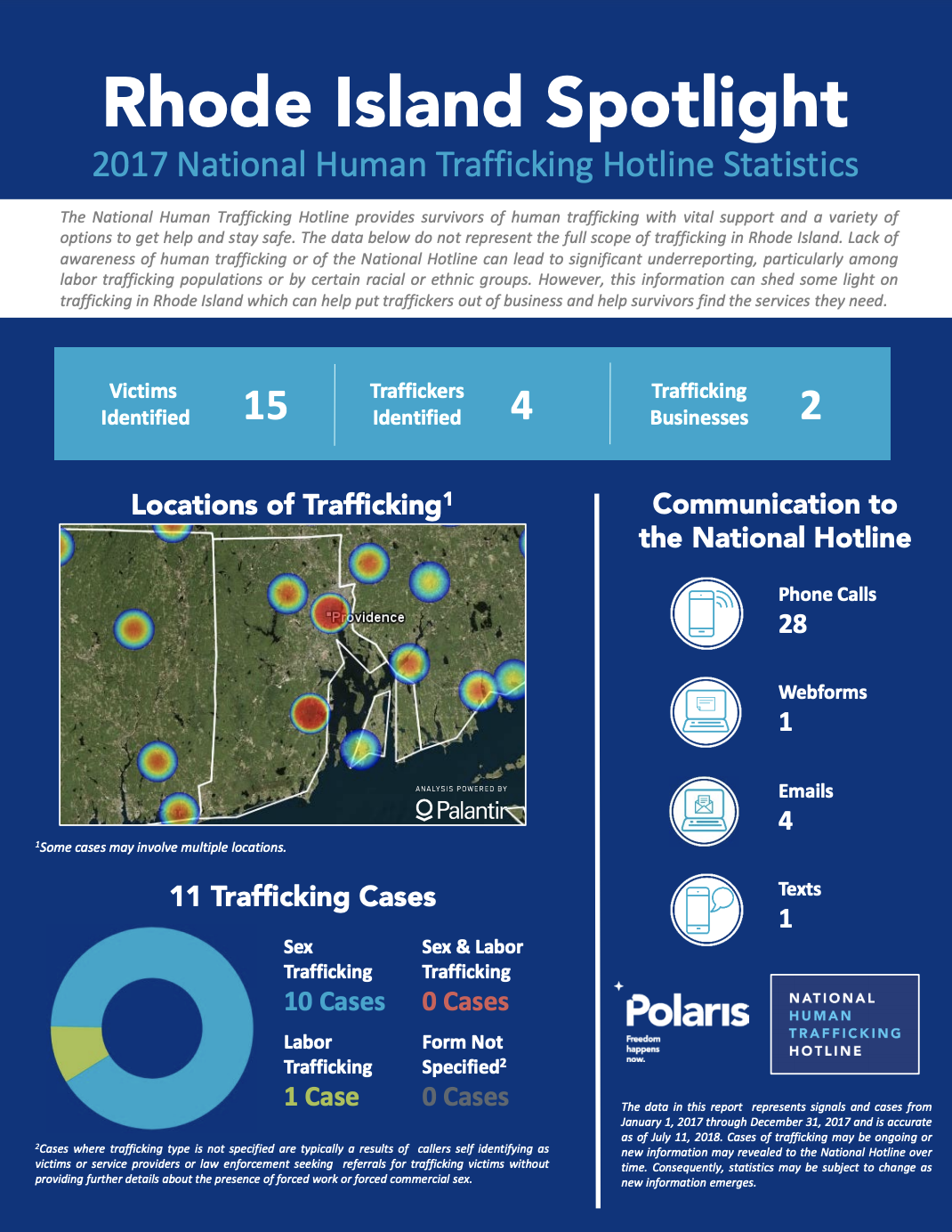
The data in this report represents signals and cases from January 1, 2017 through December 31, 2017 and is accurate as of July 11, 2018. Cases of trafficking may be ongoing or new information may be revealed to the National Hotline over time. Consequently, statistics may be subject to change as new information emerges.

You can download the report infographic below.

National Hotline 2017 Rhode Island State Report - National Human Trafficking Hotline, 2018 DOWNLOAD

post

page

attachment

revision

nav_menu_item

custom_css

customize_changeset

oembed_cache

user_request

wp_block

wp_template

wp_template_part

wp_global_styles

wp_navigation

wp_font_family

wp_font_face

acf-taxonomy

acf-post-type

acf-field-group

acf-field

ai1ec_event

exactmetrics_note

Driving Behavior Change of Recruiters, Suppliers, and Job Seekers Toward Ethical Recruitment: Critical Roles of Global Buyers and Grassroots Actors
Publications

This report was prepared by Dr. Lisa Rende Taylor and Ohnmar Ei Ei Chaw, Issara Institute. Issara Institute programming in Myanmar and Thailand over the past year has focused on driving more ethical recruitment systems, down to the ‘first mileâ...Read More

New Study on Human Trafficking for Labour Exploitation in Peru’s Logging and Gold Mining Sectors.
News & AnalysisPublications

A new study conducted by IOM and the Catholic University of Peru sheds new light on human trafficking for labour exploitation in illegal logging and gold mining in the Madre de Dios region of the country. Peru is a country of origin, transit and de...Read More

National Hotline 2018 Utah State Report
Graphics & InfographicsPublications

The data in this report represents signals and cases from January 1, 2018 through December 31, 2018 and is accurate as of July 25, 2019. Cases of trafficking may be ongoing or new information may revealed to the National Hotline over time. Consequen...Read More

Financial Industry: Modern Slavery Awareness Survey
Publications

When asked the importance of the following social and environmental issues at a personal level, over four fifths (87%) of financial services employees rate modern slavery and human trafficking as important. ...Read More