
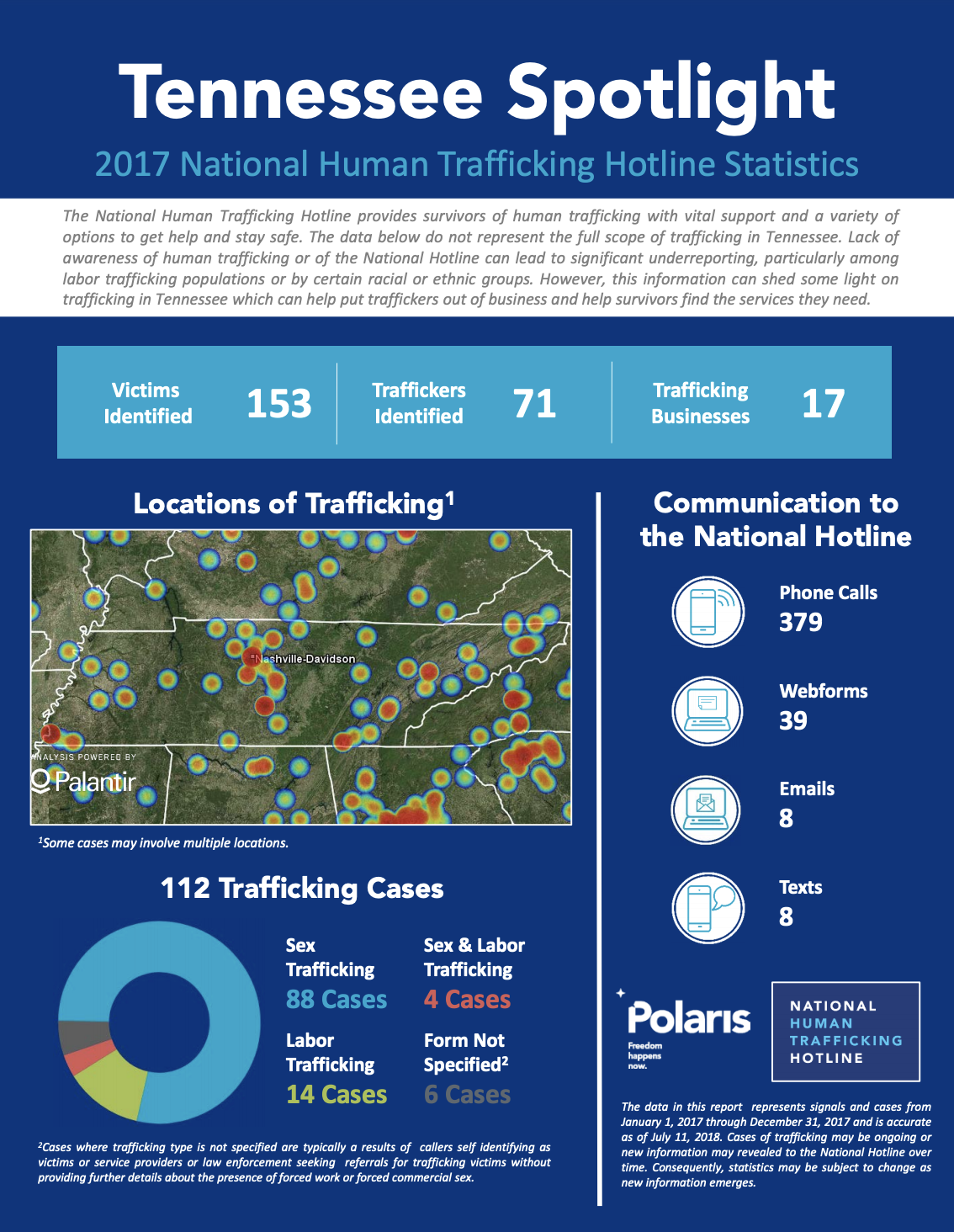
The data in this report represents signals and cases from January 1, 2017 through December 31, 2017 and is accurate as of July 11, 2018. Cases of trafficking may be ongoing or new information may be revealed to the National Hotline over time. Consequently, statistics may be subject to change as new information emerges.

You can download the report infographic below.

National Hotline 2017 Tennessee State Report - National Human Trafficking Hotline, 2018 DOWNLOAD

post

page

attachment

revision

nav_menu_item

custom_css

customize_changeset

oembed_cache

user_request

wp_block

wp_template

wp_template_part

wp_global_styles

wp_navigation

wp_font_family

wp_font_face

acf-taxonomy

acf-post-type

acf-field-group

acf-field

ai1ec_event

exactmetrics_note

‘It Has Destroyed Me’- A Legal Advice System on the Brink
News & AnalysisPublications

Access to legal advice is crucial for survivors of trafficking and modern slavery but the legal aid funding system is failing them. Survivors are not able to access timely and quality, legally aided advice and representation when they need it, with ...Read More

TAGS: Europe
Child Labour in the Arab Region – A Quantitative and Qualitative Analysis
Publications

Child labour has long been a feature of economic life in the Arab region, particularly in agriculture, small traditional craft shops, and informal industries such as garment and carpet making, as well as some construction-related activities. Childre...Read More

National Hotline 2019 Florida State Report
Graphics & InfographicsPublications

The data in this report represents signals and cases from January 1, 2019 through December 31, 2019 and is accurate as of July 30, 2020. Cases of trafficking may be ongoing or new information may revealed to the National Hotline over time. Consequen...Read More

Fishing For Data
Publications

Marine fisheries are critical resources for coastal developing countries. They are also difficult to manage sustainably. Almost a third of global fish stocks are degraded from overfishing, and a further 60% are ‘fully exploited’ (FAO, 2016). Ille...Read More