
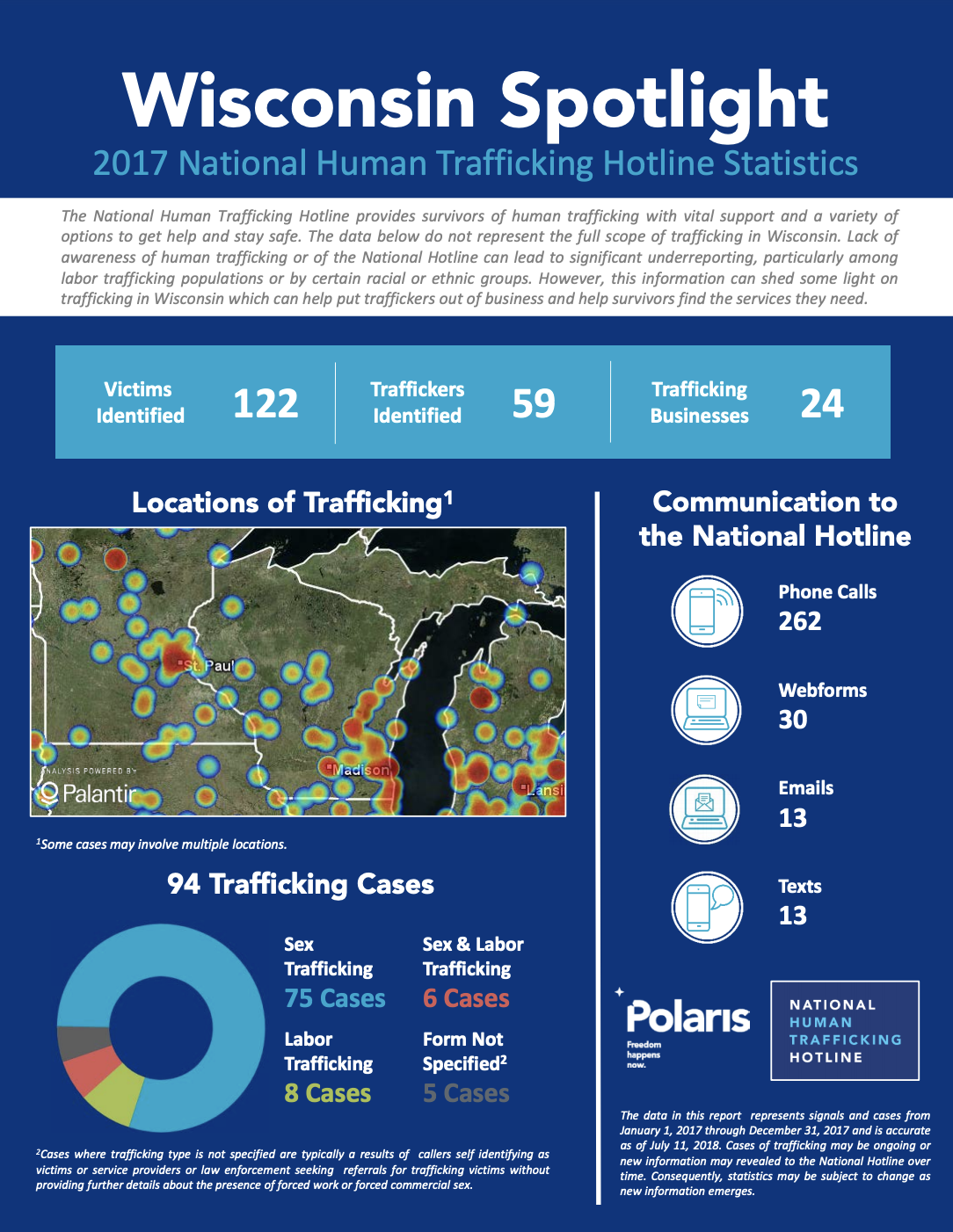
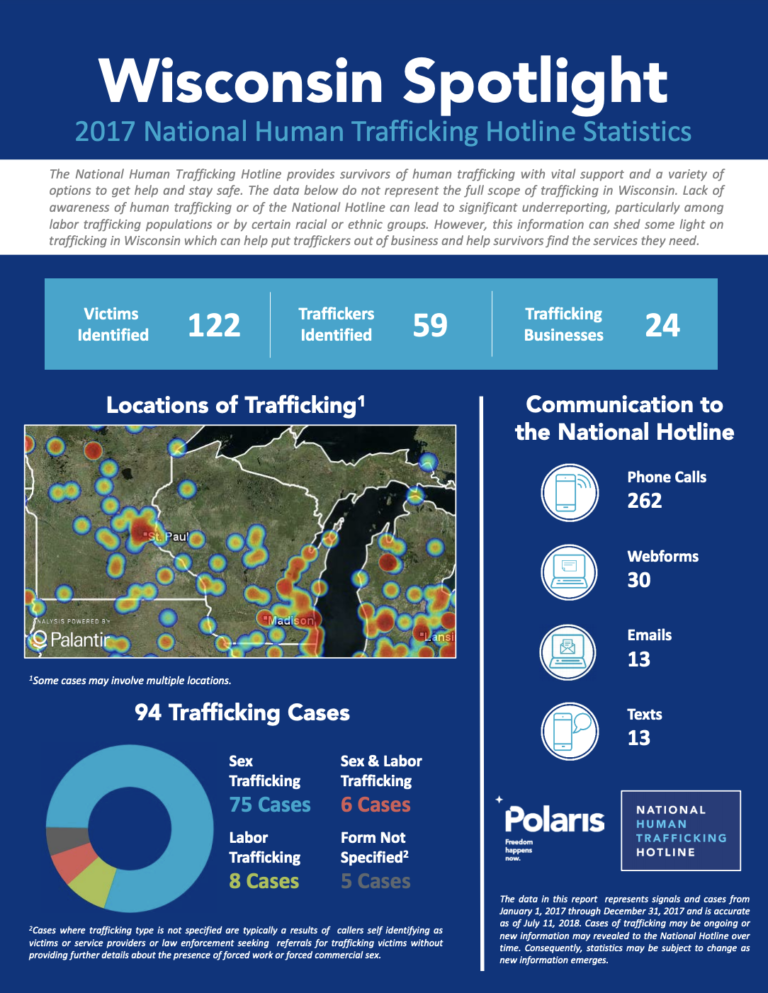
The data in this report represents signals and cases from January 1, 2017 through December 31, 2017 and is accurate as of July 11, 2018. Cases of trafficking may be ongoing or new information may be revealed to the National Hotline over time. Consequently, statistics may be subject to change as new information emerges.

You can download the report infographic below.

National Hotline 2017 Wisconsin State Report - National Human Trafficking Hotline, 2018 DOWNLOAD

post

page

attachment

revision

nav_menu_item

custom_css

customize_changeset

oembed_cache

user_request

wp_block

wp_template

wp_template_part

wp_global_styles

wp_navigation

wp_font_family

wp_font_face

acf-taxonomy

acf-post-type

acf-field-group

acf-field

ai1ec_event

exactmetrics_note

Transnational Organized Crime and the Impact on the Private Sector: The Hidden Battalions
Publications

Authors: Robin Cartwright & Frances Cleland-Bones This paper is based on the Global Initiative against Transnational Organized Crime's detailed review of the scale and nature of organised crime’s infiltration of the private sector.  These find...Read More

TAGS: Global
Corporate Human Rights Benchmark – 2018 Key Findings
Publications

The 2018 Corporate Human Rights Benchmark assesses 101 of the largest publicly traded companies in the world on a set of human rights indicators. The companies from 3 industries – Agricultural Products, Apparel, and Extractives – were chosen fo...Read More

The International Legal Definition of Trafficking in Persons: Consolidation of research findings and reflection on issues raised
GuidancePublications

Until December 2000, the term “trafficking in persons” was not defined in international law, despite its incorporation in several international legal instruments. The long-standing failure to develop an agreed-upon definition of trafficking in p...Read More

TAGS: Global
Workers’ conditions in the textile and clothing sector: just an Asian affair? Issues at stake after the Rana Plaza tragedy
Publications

Written by Enrico D'Ambrogio More than 70% of EU imports of textile and clothing come from Asia. Many Asian workers have to work in sweatshop conditions, but the issue appears in global media only when major fatal accidents occur, like that at Ra...Read More