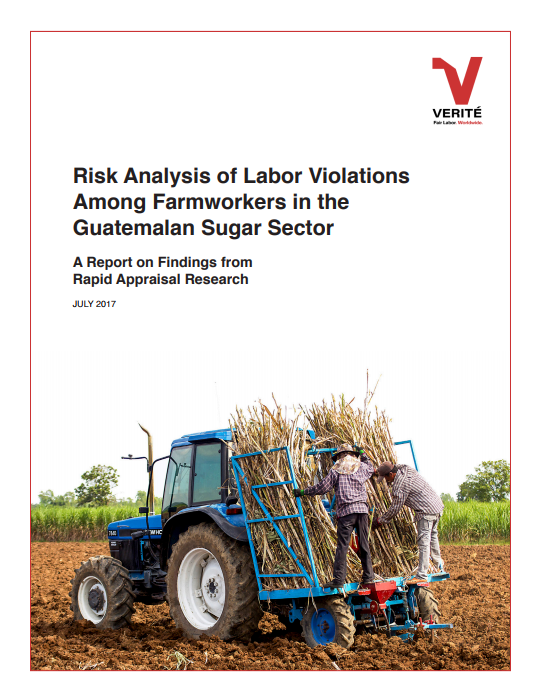
Guatemala plays a major role in the global sugar trade, as the world’s fourth largest sugar exporter and the third leading exporter of sugar to the United States in 2015. Verité chose to carry out rapid appraisal research on labour conditions on Guatemalan sugarcane plantations due to Guatemala’s important role in the global sugar trade and indications that workers employed on sugarcane plantations were vulnerable to exploitation. Past studies on labour conditions among Guatemalan and Central American agricultural workers, as well as Verité’s past research in the Guatemalan coffee and palm oil sectors, indicated a high risk of labour violations.

This rapid appraisal uncovered a wide range of very serious labour conditions on Guatemalan sugarcane plantations, including indicators of human trafficking, many of which can be linked back to structural conditions in Guatemala generally and in its agricultural sector in particular. However, it should be noted that these labour vulnerabilities in sugarcane production are not isolated to Guatemala. Sugar production worldwide is characterized by difficult, dangerous work processes often carried out by vulnerable or marginalized populations. Sugarcane producers often use recruiters to find workers for this grueling work, which can exacerbate vulnerability to labour abuses.

Risk Analysis of Labour Violations Among Farmworkers in the Guatemalan Sugar Sector - Verité 2017 DOWNLOAD

post

page

attachment

revision

nav_menu_item

custom_css

customize_changeset

oembed_cache

user_request

wp_block

wp_template

wp_template_part

wp_global_styles

wp_navigation

wp_font_family

wp_font_face

acf-taxonomy

acf-post-type

acf-field-group

acf-field

ai1ec_event

exactmetrics_note

Meneshachin scoping study: A global synthesis and analysis of responsible recruitment initiatives targeting low-wage, migrant workers
Publications

This review was conducted as a “scoping study” of two distinct areas of recruitment policy and programming: (1) current government policies and initiatives to improve recruitment standards for low-wage migrant workers; and (2) current non-govern...Read More

Assessing the Impact of Due Diligence Programs in Eastern DRC: A Baseline Study
Publications

Over the past decade, due diligence programmes (DDP) have been developed in the Great Lakes Region to trace the origins of minerals, certify minerals as conflict-free and to improve mining communities’ livelihoods while reducing human rights abuse...Read More

Impact of Covid-19 on Women Workers in the Horticulture Sector in Kenya
COVID-19 resourcesPublications

Hivos commissioned an assessment in April 2020 to establish the impact of Covid-19 on women workers in the horticulture sector. This was assessed with special focus on their current employment status, living conditions, shifts in their household exp...Read More

On Due Diligence for EU Businesses to Address the Risk of Forced Labour in their Operations and Supply Chains
Publications

Responsible business conduct by European companies plays a crucial role in ensuring that EU policies on human rights are effectively implemented, including with regard to labour. The EU is committed to promoting the implementation of responsible bus...Read More