
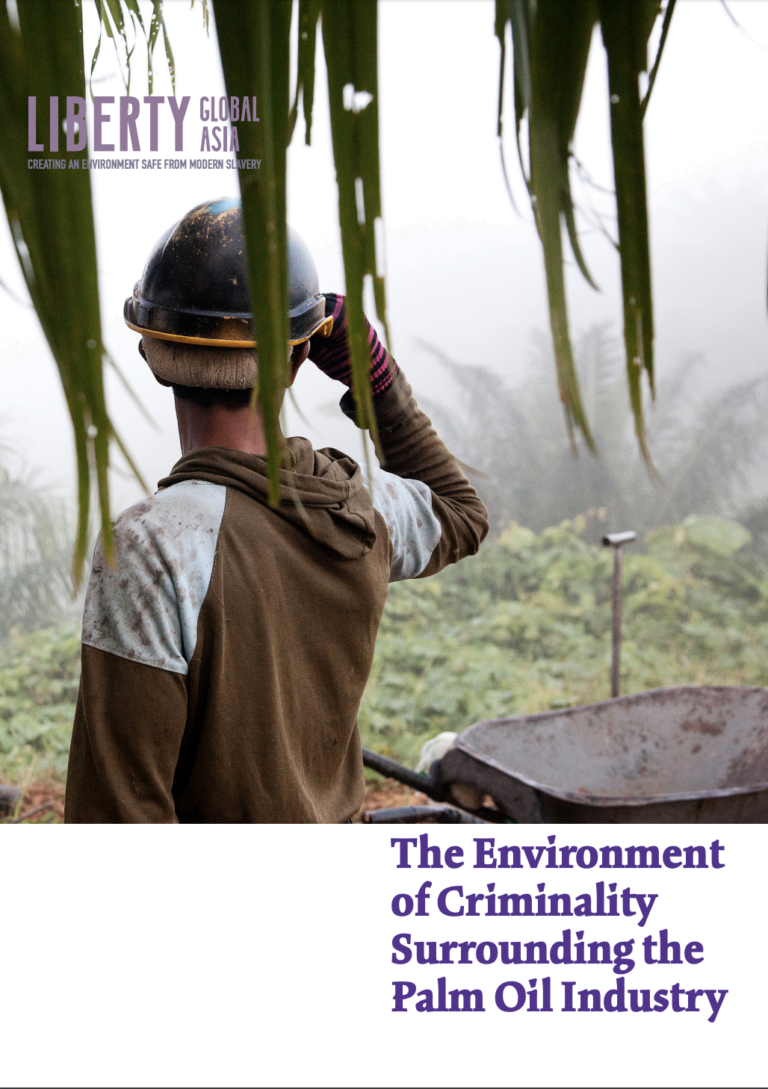
The contents of this document provide a practical assessment of risk within the wider palm oil industry structure and the urgent need for better governance, management and administration to prevent these undesirable activities from continuing and giving rise to greater risk and potential liability. More than anything, the contents of the document seek to draw the attention of stakeholders to the plight of those providing their labour and the unhealthy environment surrounding them and the palm oil industry.

The Environment of Criminality Surrounding the Palm Oil Industry - Liberty Shared Asia, 2018 DOWNLOAD

post

page

attachment

revision

nav_menu_item

custom_css

customize_changeset

oembed_cache

user_request

wp_block

wp_template

wp_template_part

wp_global_styles

wp_navigation

wp_font_family

wp_font_face

acf-taxonomy

acf-post-type

acf-field-group

acf-field

ai1ec_event

exactmetrics_note

Trafficking Victim Identification: A Practitioner’s Guide
Guidance

This Practitioner Guide distills and presents existing research and evidence on the identification (and non-identification) of trafficking victims, including challenges and barriers that may impede victim identification and practices that may enhanc...Read More

Finance & human rights: regulatory overview
GuidancePublications

This short paper is intended as a general overview of the development of different legislations and frameworks that apply in the area of finance and human rights, underlining key aspects. It comprises EU regulation (in force and upcoming), national ...Read More

Assessing Modern Slavery Risks in the Vietnam-Taiwan Migration Corridor
Guidance

This briefing note presents key findings and insights from a study conducted by Responsible Business Alliance (RBA), in collaboration with Verité, Ulula, and the Fair Hiring Initiative, with Vietnamese migrant workers at four destination workplaces...Read More

Using Worker Voice Tools to Assess Relationships Between Workers and their Managers
Guidance

This note focuses on one dimension of how technology-enabled worker voice tools can be used: to gather qualitative data about the nature of relationships between managers and workers or communities at factories, farms, mines, and plantations. This i...Read More