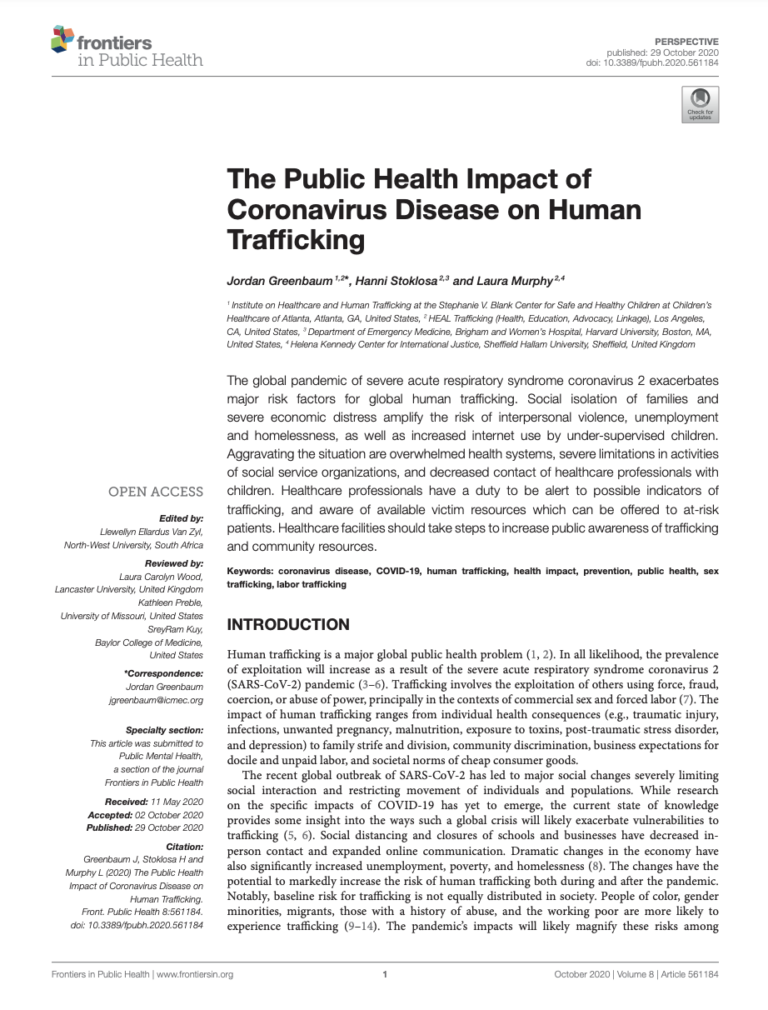
Written by Jordan Greenbaum, Hanni Stoklosa, and Laura Murphy.

The global pandemic of severe acute respiratory syndrome coronavirus exacerbates major risk factors for global human trafficking. Social isolation of families and severe economic distress amplify the risk of interpersonal violence, unemployment and homelessness, as well as increased internet use by under-supervised children. Aggravating the situation are overwhelmed health systems, severe limitations in activities of social service organisations, and decreased contact of healthcare professionals with children. Healthcare professionals have a duty to be alert to possible indicators of trafficking, and aware of available victim resources which can be offered to at-risk patients. Healthcare facilities should take steps to increase public awareness of trafficking and community resources.

The Public Health Impact of Coronavirus Disease on Human Trafficking - frontiers in Public Health, 2020 DOWNLOAD

post

page

attachment

revision

nav_menu_item

custom_css

customize_changeset

oembed_cache

user_request

wp_block

wp_template

wp_template_part

wp_global_styles

wp_navigation

wp_font_family

wp_font_face

acf-taxonomy

acf-post-type

acf-field-group

acf-field

ai1ec_event

exactmetrics_note

Crime and Contagion: The impact of a pandemic on organized crime
COVID-19 resourcesStandards & Codes of Conduct

The fallout of the COVID-19 pandemic is having profound impacts on society and the economy, and it will also influence and shape organized crime and illicit markets. The institutional response to the pandemic and the consequent reshaping of socio-ec...Read More

TAGS: Global
Covid-19: Garment Worker Perspectives
COVID-19 resourcesPublications

The coronavirus pandemic and resulting government actions to stem the spread of the virus have severely changed the way people across the world work and live. For Jordan’s garment sector, the national curfew and shutdown of business activity force...Read More

Minors in Kathmandu’s adult entertainment sector: What’s driving demand?
Publications

Kathmandu’s adult entertainment sector (AES) is made up of a complex web of venues that includes massage parlours, dance bars, cabin restaurants and guest houses. These workplaces employ young women and girls as waitresses and dancers who entertain...Read More

Corporate Social Responsibility Review: Risks of Child Labor on Select Coffee Farms in Nicaragua
Publications

In Nicaragua, coffee is mainly produced on small-scale farms where temporary or seasonal work, weak remuneration, subcontracting, migrant workers, and child labor are likely to exist. In recent years, corporate social responsibility (CSR) activitie...Read More