
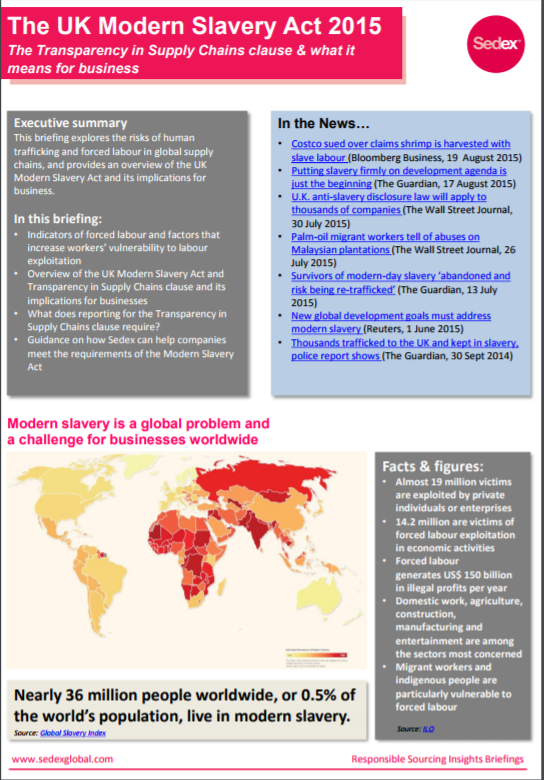
This Sedex briefing explores the risks of human trafficking and forced labour in global supply chains, providing an overview of the UK Modern Slavery Act and its implications for business.

The briefing covers:

  • Indicators of forced labour and factors that increase workers’ vulnerability to labour exploitation
  • Overview of the UK Modern Slavery Act and the Transparency in Supply Chains clause and their implications for businesses
  • What does reporting for the Transparency in Supply Chains clause require?
  • Guidance on how Sedex can help companies meet the requirements of the Modern Slavery Act
The UK Modern Slavery Act 2015. The Transparency in Supply Chains clause & what it means for businesses DOWNLOAD

post

page

attachment

revision

nav_menu_item

custom_css

customize_changeset

oembed_cache

user_request

wp_block

wp_template

wp_template_part

wp_global_styles

wp_navigation

wp_font_family

wp_font_face

acf-taxonomy

acf-post-type

acf-field-group

acf-field

ai1ec_event

exactmetrics_note

Risk Analysis of Labor Violations Among Farmworkers in the Guatemalan Sugar Sector
Guidance

Rapid appraisal research was carried out by Verité and REACH (Research-Education- Action-Change) on labour conditions in Guatemalan sugarcane production in late 2016. Researchers conducted a literature review, expert consultations, unstructure...Read More

The Equator Principles
GuidanceGood Practices

Large infrastructure and industrial Projects can have adverse impacts on people and on the environment. As financiers and advisors, we work in partnership with our clients to identify, assess and manage environmental and social risks and impacts in ...Read More

Tackling Sexual Harassment in Low-Paid and Insecure Work
Guidance

The purpose of this position paper is to inform the development of an effective labour market enforcement strategy for tackling sexual harassment in the context of low-paid and insecure work. It seeks to nuance the discussion around se...Read More

Corporate Human Rights Benchmark 2022: Insights Report
News & AnalysisGuidanceStandards & Codes of Conduct

The Corporate Human Rights Benchmark (CHRB) assessed three sectors in 2022: food and agricultural products (57 companies), ICT manufacturing (43 companies) and automotive manufacturing (29 companies). The revised CHRB methodology devotes more at...Read More

TAGS: Global