
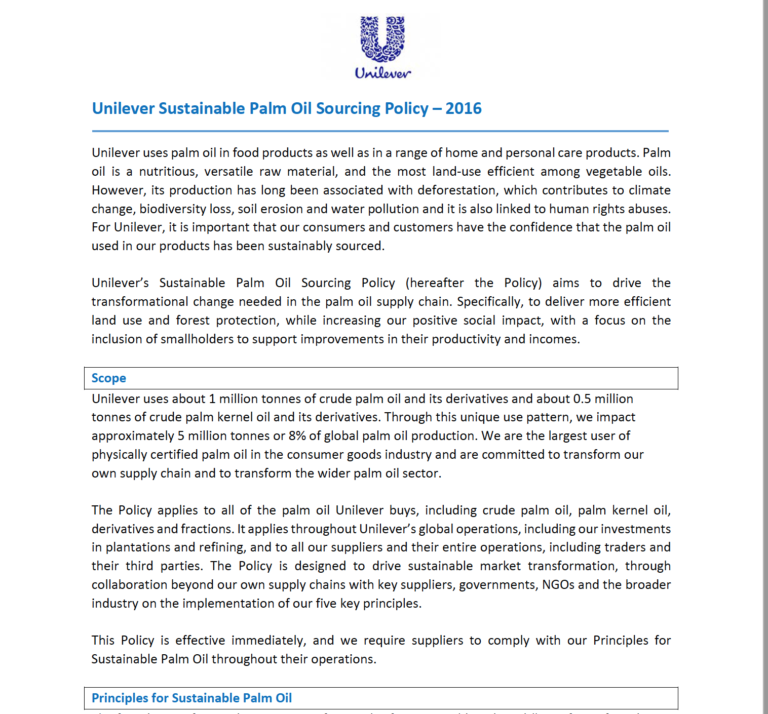
Unilever’s policy document summarizes its ethical commitment to the responsible sourcing of palm oil by transforming the supply chain with the inclusion of local stakeholders, driving changes in income and improvements productivity.  

Unilever Sustainable Palm Oil Sourcing Policy- Unilever, 2016 DOWNLOAD

post

page

attachment

revision

nav_menu_item

custom_css

customize_changeset

oembed_cache

user_request

wp_block

wp_template

wp_template_part

wp_global_styles

wp_navigation

wp_font_family

wp_font_face

acf-taxonomy

acf-post-type

acf-field-group

acf-field

ai1ec_event

exactmetrics_note

Handbook on Performance Indicators for Counter-Trafficking Projects – International Organization for Migration
GuidanceStandards & Codes of ConductGood Practices

This handbook is a resource and guide for project managers, developers, implementers, evaluators and donors working in the field of counter-trafficking, who want to develop performance indicators for their counter-trafficking projects. It is not int...Read More

Worker Voice-Driven Ethical Recruitment Toolkit
GuidanceStandards & Codes of Conduct

First released in November 2017, the Issara Worker Voice-Driven Ethical Recruitment Toolkit has been expanded and updated through the years to meet the needs of suppliers and recruitment agencies in South and Southeast Asia. This new October 2022 v...Read More

TAGS: Asia
Code of Practice for Ensuring the Rights of Victims and Survivors of Human Trafficking
Standards & Codes of Conduct

The OSCE Ofce for Democratic Institutions and Human Rights (ODIHR) has been active in preventing and combating human trafcking in the OSCE region since 1999. ODIHR address- es human trafcking through an approach that is based on human rights, rule o...Read More

TAGS:
Global Justice: Using Strategic Litigation to Combat Forced Labour
News & AnalysisStandards & Codes of ConductLegislation

Forced labor is a feature, not a bug, in today’s global economic system. Forced labor spans the globe. It involves multinational corporations. It is found in special economic zones—and war zones. And it is in everyone’s backyard. Globally, 27....Read More