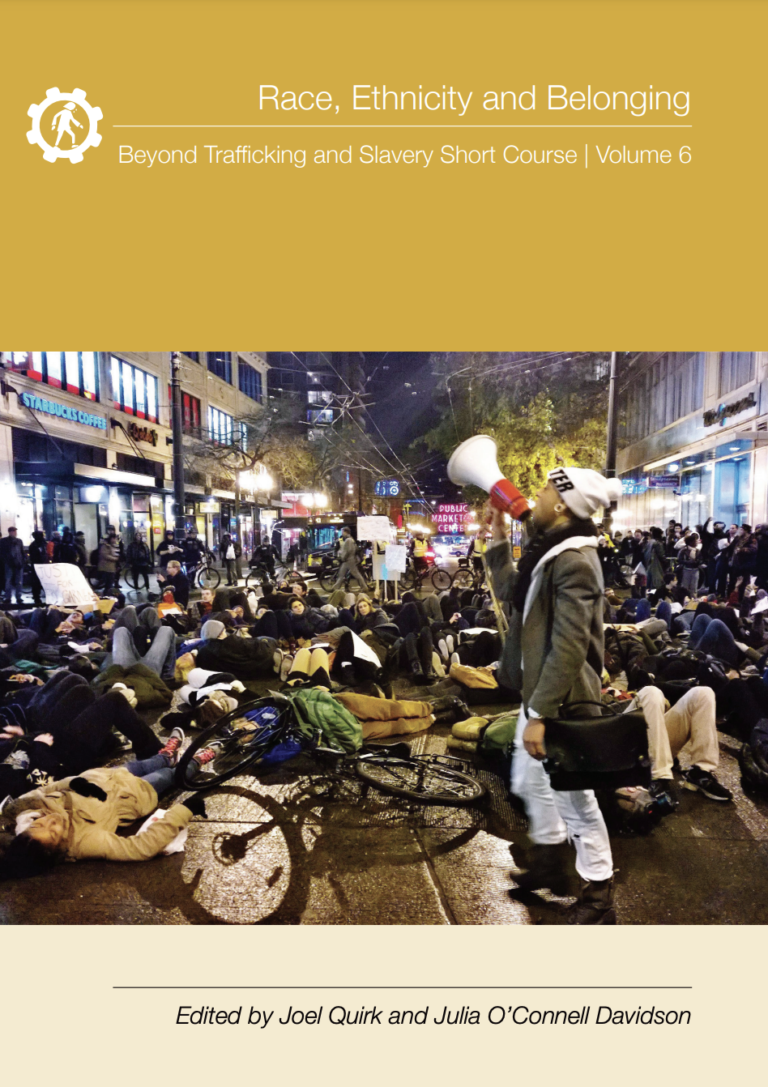
Edited by Joel Quirk and Julia O’Connell Davidson.

This is the sixth volume of the series Beyond Trafficking and Slavery Short Course.

Slavery cannot be reduced to a chapter in history that is now closed, but must instead be regarded as a continuing and fundamental wound. As recent campaigns around ‘black lives matter’ and the prison industrial complex have further demonstrated, the idea of race—and racism as a system of domination—are intimately bound up with the history and legacies of transatlantic slavery. Despite their professed concern with slavery today, self-proclaimed ‘modern-day abolitionists’ have remarkably little to say about slavery and racism. They instead argue that we need to think about poverty, rather than race, since ‘modern slavery’ is colour blind. This book seeks to expose the profound limitations of this popular approach. Over the course of twenty chapters, some of the world’s leading experts illustrate how and why racism and other forms of discrimination continue to shape contemporary patterns of marginalisation, exclusion, and government and corporate complicity.

Race, Ethnicity and Belonging - openDemocracy, 2015 DOWNLOAD

post

page

attachment

revision

nav_menu_item

custom_css

customize_changeset

oembed_cache

user_request

wp_block

wp_template

wp_template_part

wp_global_styles

wp_navigation

wp_font_family

wp_font_face

acf-taxonomy

acf-post-type

acf-field-group

acf-field

ai1ec_event

exactmetrics_note

Regional Overview: Combating the Sexual Exploitation of Children in South Asia
GuidancePublications

This report maps sexual exploitation of children in travel and tourism (SECTT), online child sexual exploitation (OCSE), trafficking of children for sexual purposes, sexual exploitation of children through prostitution, child early and forced marria...Read More

Corporate Human Rights Benchmark – 2018 Key Findings
Publications

The 2018 Corporate Human Rights Benchmark assesses 101 of the largest publicly traded companies in the world on a set of human rights indicators. The companies from 3 industries - Agricultural Products, Apparel, and Extractives - were chosen for the ...Read More

US Supermarket Supply Chains: End the Human Suffering Behind our Food
Publications

Inequality is rampant across the global economy, and the agro-food sector is no exception. At the top, big supermarkets and other corporate food giants dominate global food markets, allowing them to squeeze value from vast supply chains that span the...Read More

Sustainable fisheries and human rights: Opportunities to address the true cost of Thailand’s seafood
GuidancePublications

The fishing industry in Thailand fell under global scrutiny in 2014 for the significant human rights violations at sea. Personal stories of victims who had worked for years at sea with little food and constant physical abuse created enough global at...Read More