
Written by Cristian Eduardo and Shobana Powell.

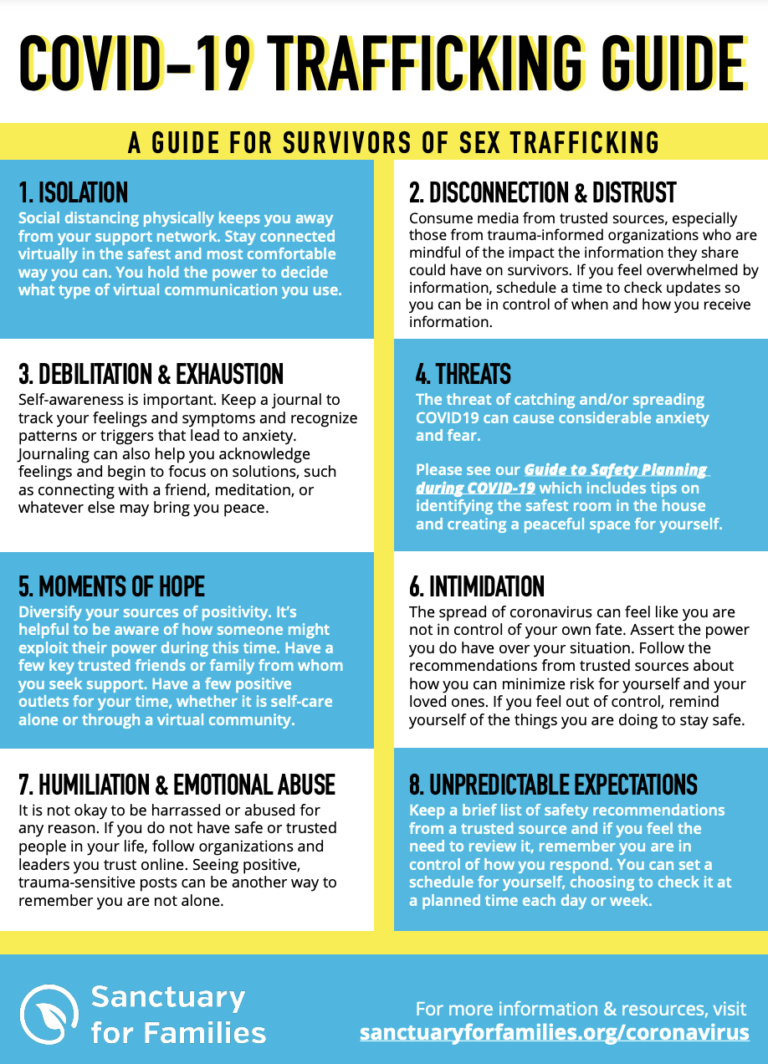
The purpose of this guide is to empower survivors and service providers with psychoeducation on how COVID-19 might be particularly triggering for survivors of human trafficking, but we acknowledge that this information might be challenging to read for some. It is written for survivors of sex trafficking who are no longer being trafficked. This guide was written by a survivor of sex and labor trafficking and a licensed mental health clinician.

A Guide for Survivors of Sex Trafficking During COVID-19 - Sanctuary for Families, 2020 DOWNLOAD

post

page

attachment

revision

nav_menu_item

custom_css

customize_changeset

oembed_cache

user_request

wp_block

wp_template

wp_template_part

wp_global_styles

wp_navigation

wp_font_family

wp_font_face

acf-taxonomy

acf-post-type

acf-field-group

acf-field

ai1ec_event

exactmetrics_note

Evidence from Japanese companies assessment on human rights due diligence
Guidance

The Human Rights Council unanimously endorsed the UN Guiding Principles on Business and Human Rights (UNGPs) in 2011. More than 10 years later, this global standard for how business should respect human rights has driven some positive change. While ...Read More

Guide of Promising Practices
Guidance

Starting from the identification of gaps and barriers in the effective protection of trafficked persons, the guide shares promising existing practices in line with a coherent referral to the most appropriate channel of protection securing their righ...Read More

Slavery and Human Trafficking: Guidance for Businesses in Scotland
Guidance

Human trafficking and exploitation are crimes that prey on the most vulnerable in society, both within Scotland and across the world. They are abuses of human rights that have life-changing negative impacts for victims. A Corporate Group has been...Read More

Understanding the Effect of the COVID-19 Pandemic on Informal Apparel Workers in Bangladesh
COVID-19 resources

This briefing presents the results of a survey conducted with informal Ready-made Garment (RMG) workers in Bangladesh to assess their heightened vulnerabilities during the COVID-19 pandemic in relation to food security, debt, reduced employment, and...Read More