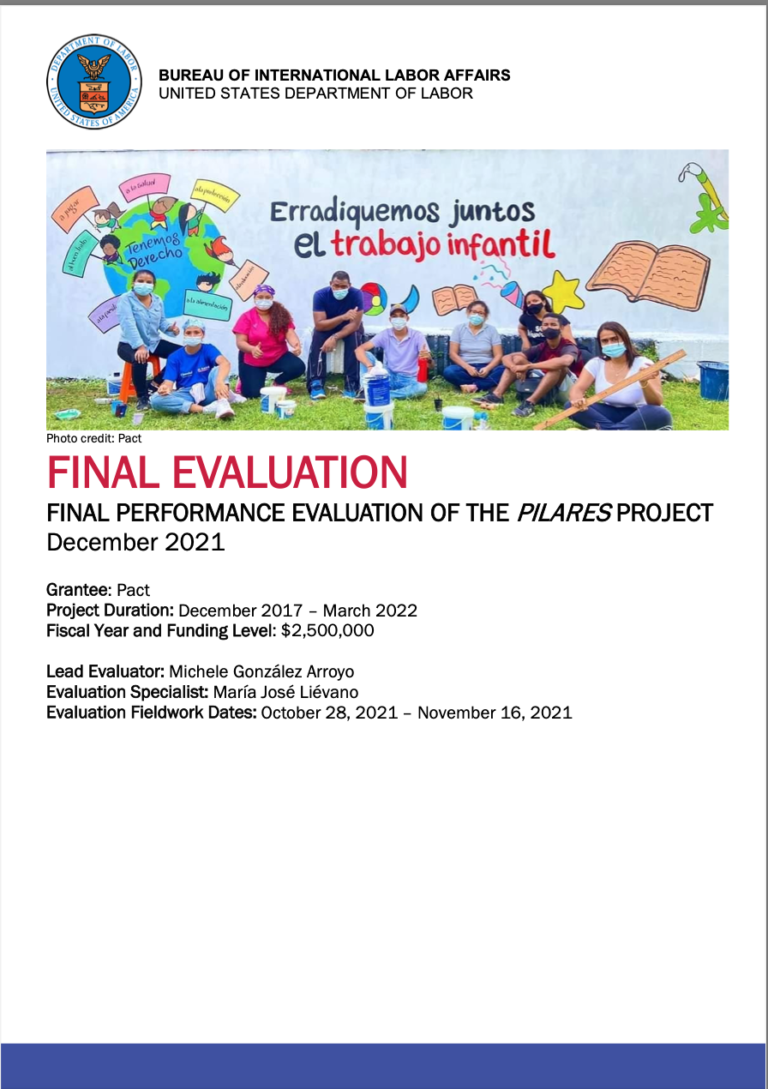
On December 15, 2017, USDOL/ILAB awarded Pact U.S. $2,000,000 over a three-year period to support the project entitled “Building the Capacity of Civil Society to Combat Child Labor and Forced Labor and Improve Working Conditions,” or “Pilares” (Spanish for “pillars”). In September 2020, USDOL awarded Pact an additional $500,000 and a 12-month extension to implement recommendations from the midterm evaluation and further strengthen the capacity of Civil Society Organizations (CSOs). A subsequent 3-month no-cost extension brought the total funding amount to $2,500,000 and a new project end date of March 2022.

The Pilares project is intended to forward progress in reducing child labor (CL) and promoting acceptable conditions of work (ACW) in Colombia’s ASGM sector through the work of CSOs. The project has been implemented in four municipalities in which ASGM is an essential source of livelihood, and in which CL and OUWC are prevalent: El Bagre and Zaragoza in the Bajo Cauca region, department of Antioquia; and Barranco de Loba and San Martín de Loba in the Sur de Bolívar region, department of Bolívar. The two targeted regions of Bajo Cauca and Sur de Bolivar experience high rates of poverty, illegal economies, and armed conflict. As such, they have been prioritized by the Government of Colombia’s Agency of Territorial Renovation for regional development programming in support of the peace process.

Final Evaluation: Final Performance Evaluation of the Pilares Project - Bureau of International Labor Affairs (US Department of Labor), December 2021 DOWNLOAD

post

page

attachment

revision

nav_menu_item

custom_css

customize_changeset

oembed_cache

user_request

wp_block

wp_template

wp_template_part

wp_global_styles

wp_navigation

wp_font_family

wp_font_face

acf-taxonomy

acf-post-type

acf-field-group

acf-field

ai1ec_event

exactmetrics_note

Labor Share and Value Distribution
Guidance

This work is part of a series of Forced Labour Evidence Briefs that seek to bring academic research to bear on calls to address the root causes of the phenomenon in global supply chains and catalyse systemic change. To do so, the Briefs consolidate ...Read More

Psychometric Measures of Empowerment and Disempowerment of Survivors of Human Trafficking
Guidance

Prepared by Sanjeev Dasgupta and Ana Maria Soto, Issara Institute. According to the 2017 Global Estimates of Modern Slavery, there are about 40 million people living in modern slavery situations worldwide. The Asia-Pacific region has the highest...Read More

2018 Statistics from the National Human Trafficking
GuidanceGood Practices

The U.S. National Human Trafficking Hotline provides survivors of human trafficking with vital support and options to get help and stay safe. These options may include connecting callers with emergency shelter, transportation, trauma counselors, loc...Read More

Trafficking in Human Beings and Terrorism: Where and How They Intersect
Guidance

Since trafficking in human beings continues to evolve, with criminals employing ever more sophisticated, a multi-disciplinary approach to combat trafficking is not only recommended but necessary. In recent years, several reports have emerged alludin...Read More

TAGS: Global