
This toolkit aims to help companies that work in corporate supply chains to quickly identify areas of their business which carry the highest risk of modern slavery and develop a simple plan to prevent and address any identified risks. It is designed particularly for small and medium-sized enterprises (SMEs), which typically face the greatest modern slavery risks across supply chains, but can be considered a resource for companies of all sizes as they get started.

Addressing forced labor and other modern slavery risks: A toolkit for corporate suppliers - Global Business Coalition Against Human Trafficking (GBCAT), June 2021 DOWNLOAD
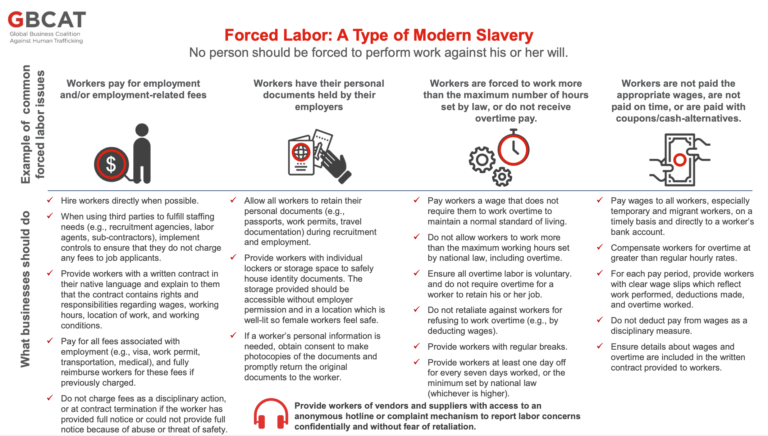
Forced Labor: A Type of Modern Slavery_infographic - Global Business Coalition Against Human Trafficking (GBCAT), June 2021 DOWNLOAD
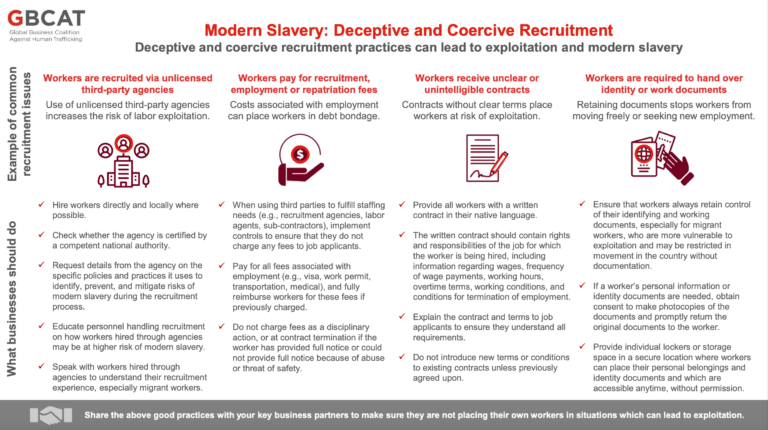
Modern Slavery: Deceptive and Coercive Recruitment_infographic - Global Business Coalition Against Human Trafficking (GBCAT), June 2021 DOWNLOAD

post

page

attachment

revision

nav_menu_item

custom_css

customize_changeset

oembed_cache

user_request

wp_block

wp_template

wp_template_part

wp_global_styles

wp_navigation

wp_font_family

wp_font_face

acf-taxonomy

acf-post-type

acf-field-group

acf-field

ai1ec_event

exactmetrics_note

Forced labor in supply chains: Addressing risks and safeguarding workers’ freedoms
Guidance

Forced labor, trafficking, and modern slavery (referred to collectively herein as forced labor) are human rights abuses persistent in global supply chains. The International Labour Organization (ILO) estimates that, in 2016, 16 million people&n...Read More

Preventing Modern Slavery and Human Trafficking: An Agenda for Action across the Financial Services Sector
Guidance

There are over 40 million people in modern slavery worldwide. Modern slavery exists in every industry, in every country in the world. The financial services industry has a major role to play in combating this violent and abusive business. And yet ou...Read More

COVID -19 Pandemic Trafficking in Persons considerations in internal displacement contexts
COVID-19 resourcesGuidance

Trafficking occurs before, during, and after crises. It may occur at any stage of displacement and in any location. Traffickers capitalize on the widespread human, material, social and economic losses and consequent vulnerabilities caused by emergen...Read More

Guidelines for the Development of a Transnational Referral Mechanism for Trafficked Persons in Europe: TRM-EU
Guidance

Considering the intrinsic transnational nature of trafficking, the partners of the project “Development of a Transnational Referral Mechanism for Victims of Trafficking between Countries of Origin and Destination – TRM-EU” decided to develop a...Read More