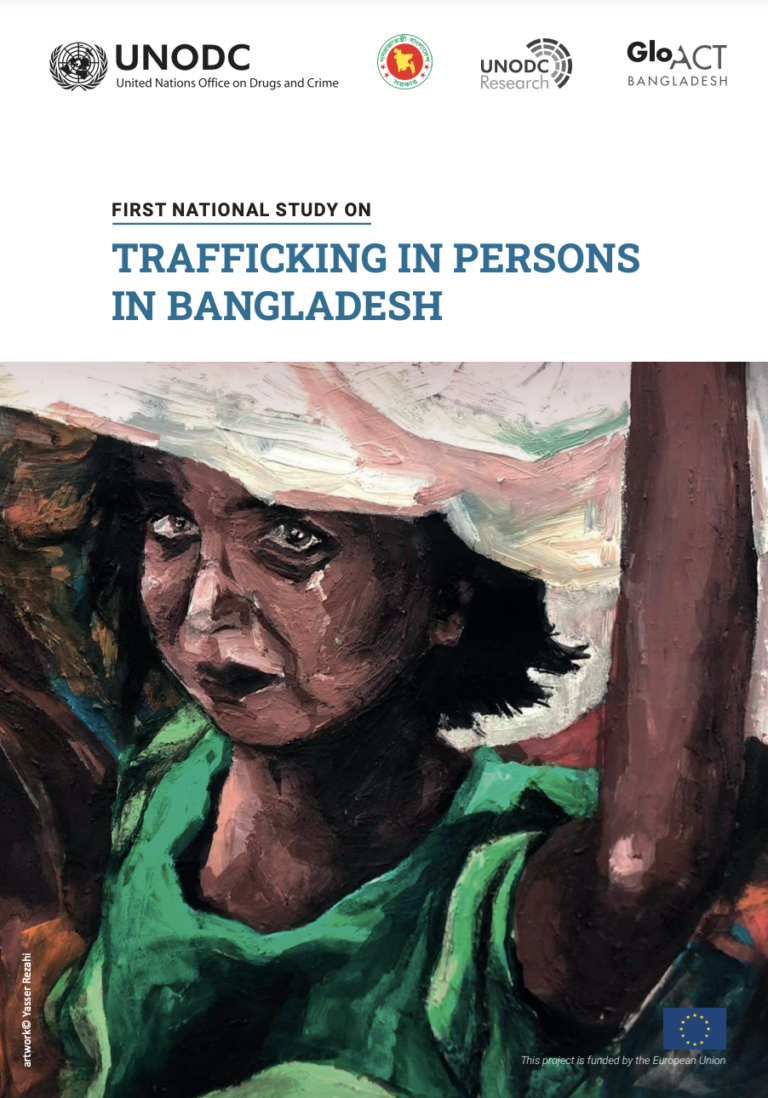
Bangladeshi victims of trafficking in persons are identified in many countries across the world, as well as in Bangladesh itself. The country’s geographic location contributes to it not only being a significant origin country of victims regionally, but also a destination for trafficking victims from neighbouring countries and from further afield. The country’s medium human development index (HDI) (0.661), poverty levels, and lack of economic opportunities for many, push people to seek employment abroad, where some end up in situations of trafficking in persons.

Against this backdrop, the First National Study on Trafficking in Persons in Bangladesh examines how the crime is committed and the victims it targets in Bangladesh. The Study is a result of partnership between the Government of Bangladesh and the UN Office on Drugs and Crime (UNODC). To provide a baseline for the trafficking situation in the country, the Study explores trafficking trends, characteristics and routes, as well as examining risk factors and the modus operandi of traffickers, and setting out national responses to the crime.

First National Study on Trafficking in Persons in Bangladesh - United Nations Office on Drugs and Crime, 2022 DOWNLOAD

post

page

attachment

revision

nav_menu_item

custom_css

customize_changeset

oembed_cache

user_request

wp_block

wp_template

wp_template_part

wp_global_styles

wp_navigation

wp_font_family

wp_font_face

acf-taxonomy

acf-post-type

acf-field-group

acf-field

ai1ec_event

exactmetrics_note

Combatting Modern Slavery through Data, Technology and Partnerships
Publications

Many valuable, but often fragmented models are currently used in the fight against human trafficking. Building from the themes raised in a five-part webinar series hosted by Freedom Collaborative last fall, this paper argues that data should be used...Read More

TAGS:
Improving our Response to Modern Slavery & Exploitation: Supporting Chinese women
Publications

Anyone can be exploited, or become a victim of modern slavery, no matter their age, gender or nationality. This report focuses specifically on Chinese women, due to the experiences of Caritas Bakhita House, Rahab and Tamar. It is hoped that it can s...Read More

Agents for change. How public procurers can influence labour conditions in global supply chains. Case studies from Brazil, Pakistan and Thailand
Publications

The report focuses on the social aspects of supply chains and examines how contracting authorities in the EU can use social criteria to improve labour conditions in countries where poor labour standards are rife. The report draws on experiences an...Read More

The Prevalence of Domestic Servitude among Child Domestic Workers in Addis Ababa, Ethiopia: Research Findings
News & AnalysisPublications

It is estimated that there are 17.2 million child domestic workers globally, most of whom are girls (International Labor Organization (ILO), 2013; ILO, n.d.). Despite their large numbers, research related to this marginalised group is extremely limi...Read More