
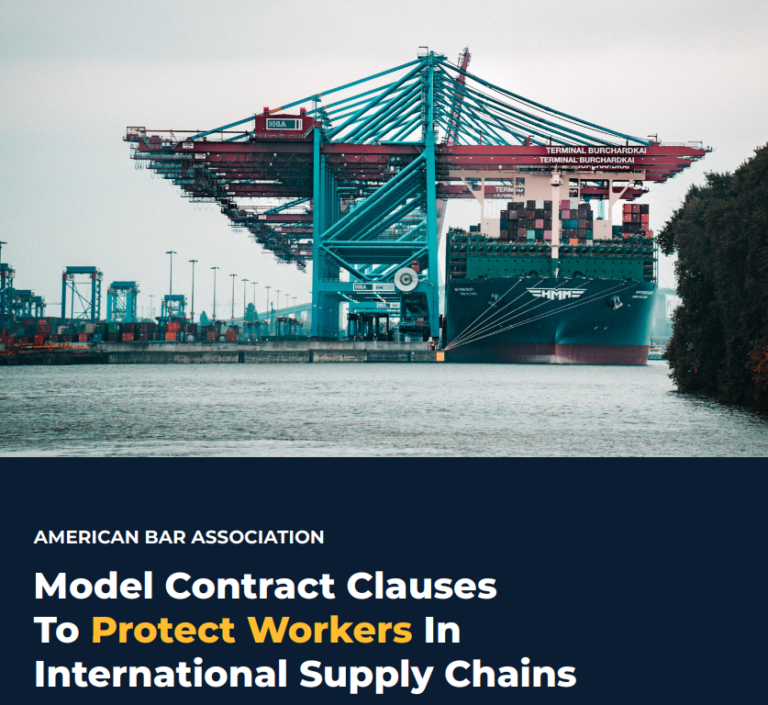
The American Bar Association (ABA) Business Law Section Working Group undertook an extensive project to help buyers and suppliers redesign their contracts to better protect human rights in supply chains, with a focus on a cooperative approach with shared responsibility.

This toolkit provides an overview of the ABA Model Contract Clauses (Versio n 2.0) (MCCs). We are not seeking to reproduce the clauses or guidance notes here, but simply to guide Mekong Club members to the relevant sections of the MCCs and related materials and highlight some of the key provisions.

Model Contract Clauses To Protect Workers In International Supply Chains - Mekong Club, 2023 DOWNLOAD

post

page

attachment

revision

nav_menu_item

custom_css

customize_changeset

oembed_cache

user_request

wp_block

wp_template

wp_template_part

wp_global_styles

wp_navigation

wp_font_family

wp_font_face

acf-taxonomy

acf-post-type

acf-field-group

acf-field

ai1ec_event

exactmetrics_note

Preventing human trafficking of refugees from Ukraine: A rapid assessment of risks and gaps in the anti-trafficking response
Guidance

The Russian invasion of Ukraine has led to the largest movement of people in Europe since World War II. Those who are fleeing the war in Ukraine are in an extremely vulnerable position. Experience from conflicts worldwide shows that the instability ...Read More

Appropriations Briefing Book
GuidanceGood Practices

This briefing book provides concrete recommendations from the Alliance to End Slavery and Trafficking (ATEST) that articulate how Congress can provide resources that are critical to ensure that the U.S. government is taking a comprehensive, victim-c...Read More

Child Rights and Homeworkers in Textile and Handicraft Supply Chains in Asia
Guidance

This study takes a child rights lens to the topic of work in home-based and small workshop settings in Asia. As home-work often is associated with child labour, the topic is picked up rather gingerly, where at the same time some industries are infam...Read More

COVID-19: How to include marginalized and vulnerable people in risk communication and community engagement
COVID-19 resourcesGuidance

Women, the elderly, adolescents, youth, and children, persons with disabilities, indigenous populations, refugees, migrants, and minorities experience the highest degree of socio-economic marginalization. Marginalized people become even more vulnera...Read More

TAGS: Global