
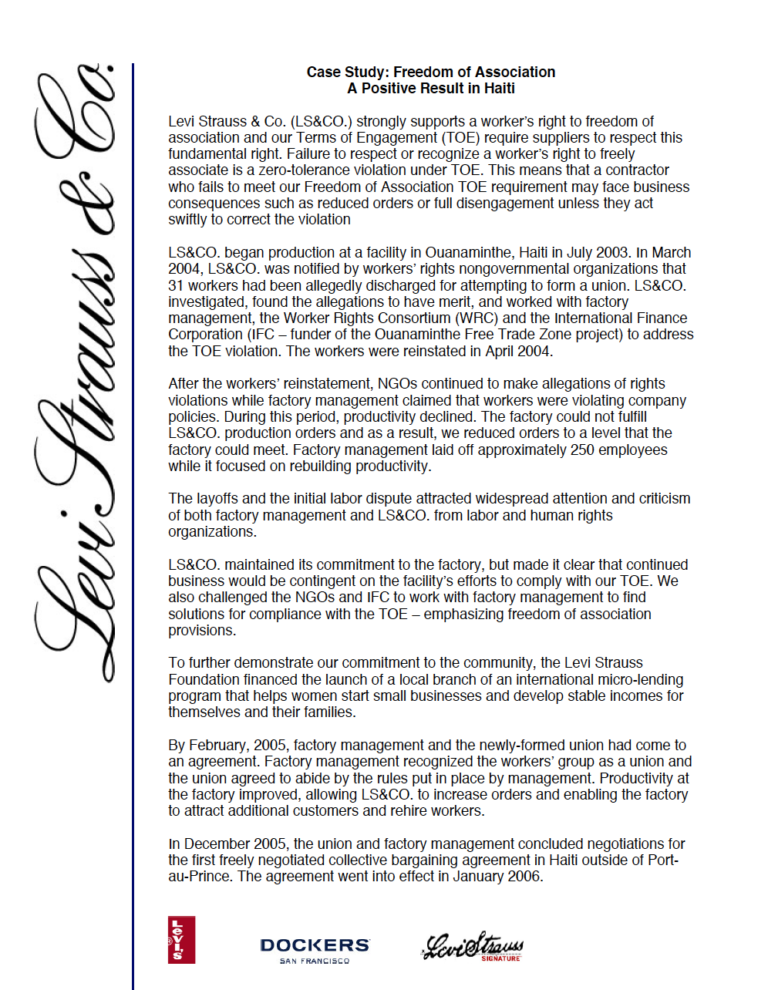
This document features a case study Levi Strauss & Co. conducted in its factory in Ouanaminthe, Haiti. When it received reports from nongovernmental organizations about workers’ rights violations in its factory, Levi Strauss & Co. took steps to enforce their Terms of Engagement with an emphasis on the right to associate. Because of these measures, the factory workers were able to unionize, improving the factory’s overall productivity.

Case Study: Freedom of Association, A Positive Effect in Haiti - Levi Strauss & Co., 2014 DOWNLOAD

post

page

attachment

revision

nav_menu_item

custom_css

customize_changeset

oembed_cache

user_request

wp_block

wp_template

wp_template_part

wp_global_styles

wp_navigation

wp_font_family

wp_font_face

acf-taxonomy

acf-post-type

acf-field-group

acf-field

ai1ec_event

exactmetrics_note

An Ethical Framework for Cross-Border Labour Recruitment
Good Practices

The Ethical Framework for Cross Border Labour Recruitment offers a set of specific operational practices (“Standards of Ethical Practice”) for recruitment firms that operate across borders. These practices are reinforced by a Verification and Cer...Read More

Adidas Code of Conduct for Suppliers: ‘Workplace Standards’
Standards & Codes of ConductGood Practices

The Workplace Standards are rules Adidas applies at their own sites and our suppliers’ factories to cover health and safety, labor rights and environmental protection. The Standards draw from international law and the International Labour Organi...Read More

Regulating labour recruitment to prevent human trafficking and to foster fair migration: Models, challenges and opportunities
Good Practices

This working paper presents the role of international labour standards in regulating recruitment and provides a preliminary overview of national laws, policies, regulations and enforcement mechanism which aim to prevent fraudulent recruitment practi...Read More

TAGS: Global
Repayment of Recruiting Fees to Workers – 4 Emerging Best Practices
GuidanceGood Practices

Issara Institute, founded in 2014, has been working on advancing more ethical recruitment practices within supply chains since its founding, including work on aspects of ethical recruitment such as more transparent, ethical terms of engagement, more...Read More