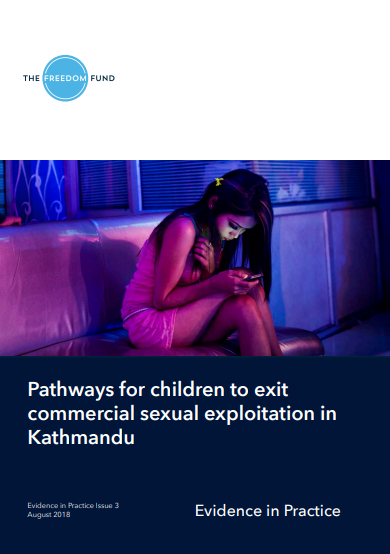
Commercial sexual exploitation of children (CSEC) affects an estimated 1.8 million children globally. In Nepal, the adult entertainment sector (AES) is recognised as a high-risk environment for children where sexual exploitation is known to occur. The sector includes venues such as restaurants, folk dance bars, erotic dance bars, massage parlours, guest houses and hotels. Not all these venues are exploitative or engage children in sexual services. However, working in these venues can lead many girls and young women to a gradual or forced familiarisation with, and immersion in, the sex industry.

In 2016, the Freedom Fund partnered with the University of Hong Kong, Griffith University and Terre des hommes Foundation in Nepal to conduct research on services that support girls and young women in Kathmandu to exit situations of commercial sexual exploitation in the AES. The specific aim of the study was to identify what services and systems are needed for girls to speedily, safely and permanently leave the AES.

This Evidence in Practice report offers recommendations for policy makers, service providers and funders working to end the commercial sexual exploitation of children. The report was prepared by the Freedom Fund, based on a longer research paper led by Dr Lucy Jordon at the University of Hong Kong.

Pathways for children to exit commercial sexual exploitation in Kathmandu - The Freedom Fund, 2018 DOWNLOAD

post

page

attachment

revision

nav_menu_item

custom_css

customize_changeset

oembed_cache

user_request

wp_block

wp_template

wp_template_part

wp_global_styles

wp_navigation

wp_font_family

wp_font_face

acf-taxonomy

acf-post-type

acf-field-group

acf-field

ai1ec_event

exactmetrics_note

Eliminating Child Labour in Malawi
Publications

British American Tobacco co‐founded the Eliminating Child Labour in Tobacco Growing Foundation (ECLT) in October 2000 and launched its pilot project in Malawi. This paper investigates the tobacco industry in Malawi. ...Read More

Workers’ conditions in the textile and clothing sector: just an Asian affair? Issues at stake after the Rana Plaza tragedy
Publications

Written by Enrico D'Ambrogio More than 70% of EU imports of textile and clothing come from Asia. Many Asian workers have to work in sweatshop conditions, but the issue appears in global media only when major fatal accidents occur, like that at Ra...Read More

The Effects of COVID‑19 on Trade and Global Supply Chains
COVID-19 resourcesPublications

The purpose of this brief is to provide an analysis of the near-term effects of the COVID‑19 pandemic on enterprises and workers engaged in trade and GSC-related activities and to explore the medium and long-term implications of the pandemic on su...Read More

World Employment and Social Outlook: Trends 2023
Publications

This year’s World Employment and Social Outlook: Trends provides a comprehensive assessment of current decent work deficits and how these have been exacerbated by multiple, overlapping crises in recent years. It analyses global patterns, regional ...Read More