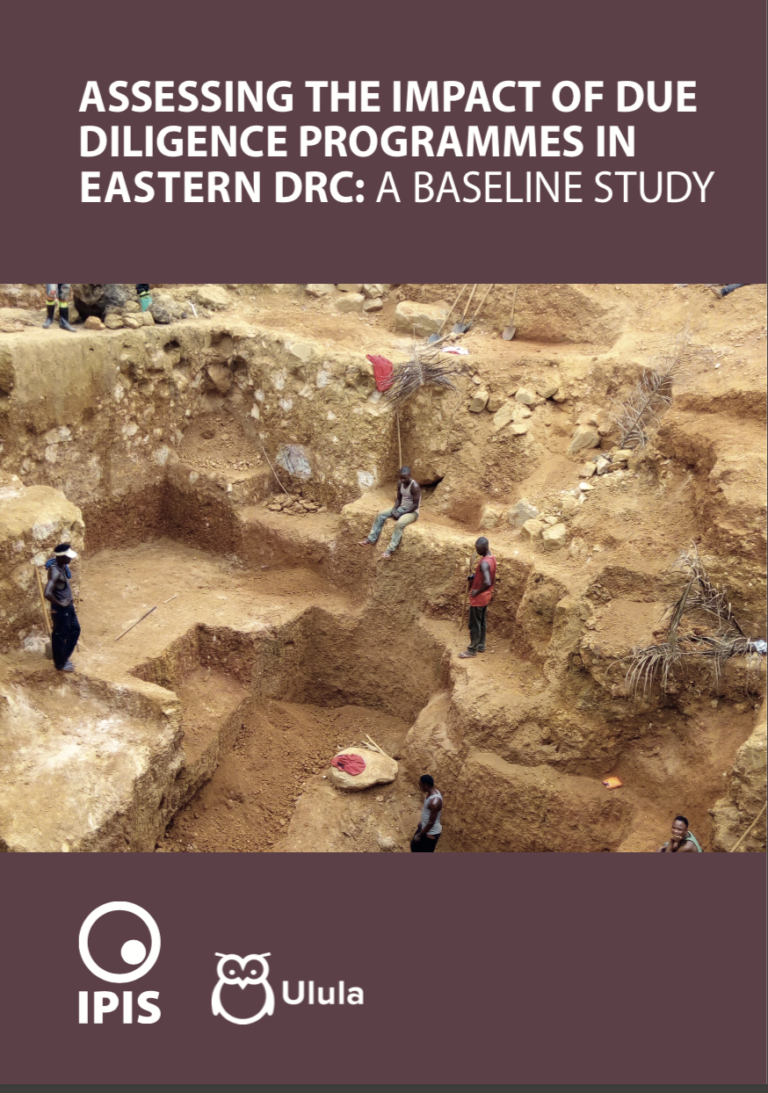
Over the past decade, due diligence programmes (DDP) have been developed in the Great Lakes Region to trace the origins of minerals, certify minerals as conflict-free and to improve mining communities’ livelihoods while reducing human rights abuses in conflict affected and high-risk areas, with a special focus on the Great Lakes region. Despite significant growth and investment in minerals certification and traceability programmes, data on the impact of due diligence for miners and communities remains scarce. The International Peace Information Service (IPIS) and Ulula designed and conducted a social, environmental and human rights assessment of the impact of due diligence programmes in mining communities in the eastern provinces of the Democratic Republic of Congo (DRC). This report presents findings from an analysis based on a combination of field visits in mining sites and remote mobile phone surveys targeting people living in and around mining communities. The collection of primary data from both mining sites and individuals living in and around the sites aims to provide preliminary research findings on the impact of due diligence programmes on social, environmental and human rights indicators in eastern DRC.

Assessing the Impact of Due Diligence Programs in Eastern DRC: A Baseline Study DOWNLOAD

post

page

attachment

revision

nav_menu_item

custom_css

customize_changeset

oembed_cache

user_request

wp_block

wp_template

wp_template_part

wp_global_styles

wp_navigation

wp_font_family

wp_font_face

acf-taxonomy

acf-post-type

acf-field-group

acf-field

ai1ec_event

exactmetrics_note

Out of the Shadows: Index 2022
Publications

The drive to prevent and respond to child sexual exploitation and abuse (CSEA) is widespread and there have been efforts to highlight CSEA’s global threat, to clear the path for victim-survivors to speak-up and to build the capacity of those worki...Read More

TAGS: Global
Modern Slavery: A Resource Guide for The Banking Industry
Publications

Every four seconds, someone is sold into modern slavery somewhere in the world. Every 60 seconds, the criminal industry that supports modern slavery makes more than US$285,000. These statistics, calculated from estimates by the International Labor O...Read More

Developing a Financially Viable Ethical Recruitment Model: Prospects for the Myanmar-Thailand Recruitment Channel
Publications

Prepared by Mark Taylor, Issara Institute. This paper provides an analysis and perspective of labour recruitment along the Myanmar-Thailand corridor– the largest source and destination countries for migrant workers within the intra-ASEAN regio...Read More

The Role of the Financial Sector in Eradicating Modern Slavery: CEOs Respond to the Independent Anti-Slavery Commissioner
Publications

However, business leaders need to collaborate in order to do this. My recommendations focus on the need to develop relevant risk management processes and the need to create better systems to share intelligence. I also strongly encourage growing coll...Read More