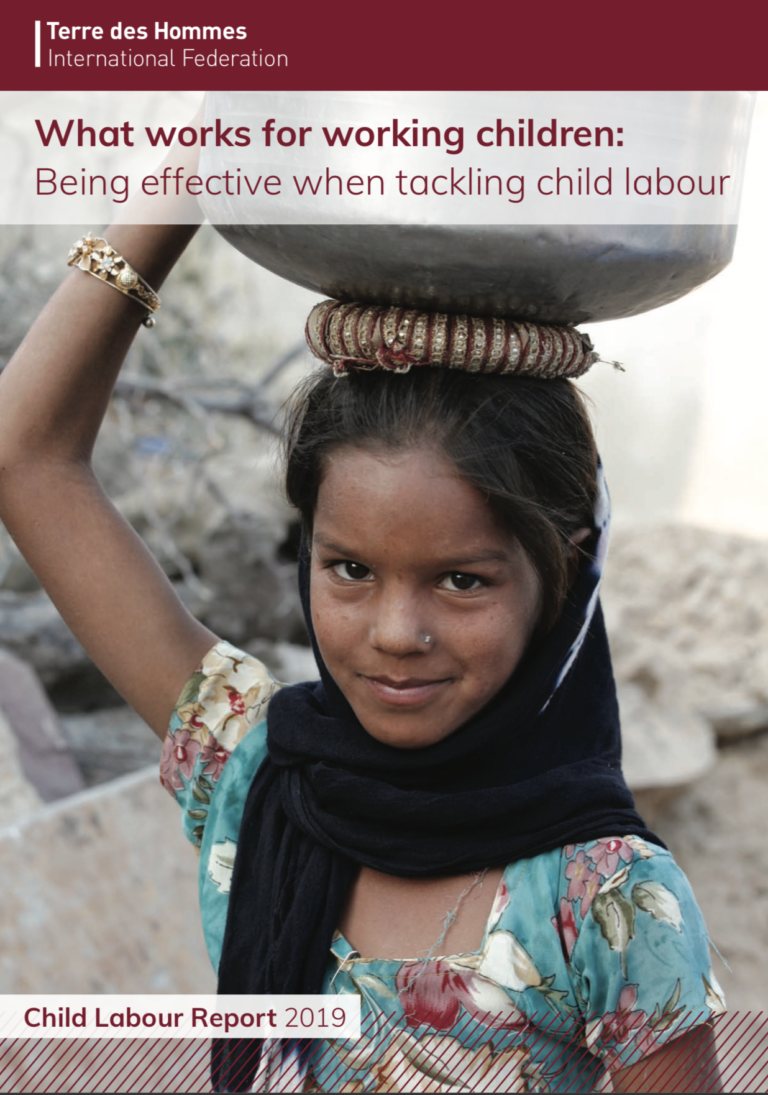
This report describes examples of methods used by Terre des Hommes, their partners around the world and other relevant stakeholders to address child labour successfully. Terre des Hommes reckons the methods described are appropriate for others to replicate when striving to achieve Target 8.7 of the Sustainable Development Goals, which includes taking “immediate and effective measures to eradicate forced labour…and secure the prohibition and elimination of the worst forms of child labour…and by 2025 end child labour in all its forms”.

The report describes five different sorts of interventions to tackle child labour and highlights the benefits of involving working children themselves in these methods, both to find out what changes in their lives the children say are most needed and to involve them in the action taken. The tendency to regard child labourers as passive ‘objects’ of actions taken by others rather than actors in their own right is one reason, in TDH’s view, that many programmes to eradicate child labour have been only partially successful or have caused collateral damage to the children who were intended to benefit.

What Works for Working Children: Being Effective When Tackling Child Labour DOWNLOAD

post

page

attachment

revision

nav_menu_item

custom_css

customize_changeset

oembed_cache

user_request

wp_block

wp_template

wp_template_part

wp_global_styles

wp_navigation

wp_font_family

wp_font_face

acf-taxonomy

acf-post-type

acf-field-group

acf-field

ai1ec_event

exactmetrics_note

Modern Slavery: Statutory Guidance for England and Wales (under s49 of the Modern Slavery Act 2015) and Non-Statutory Guidance for Scotland and Northern Ireland
Guidance

‘The best idea is to think of the victim in terms of rehabilitation and work towards it. You are working with people who have been in an environment where they were slaves; they now need to learn how to be in an environment where they are human. S...Read More

TAGS:
ASEAN Convention Against Trafficking in Persons, Especially Women and Children: 5 Years On Baseline Report 2020
Guidance

2020 marked the five-year anniversary of the signing of the ASEAN Convention Against Trafficking in Persons, Especially Women and Children (the Convention). The ASEAN-Australia Counter Trafficking Programme (ASEAN ACT) is a 10-year partnership fu...Read More

Blueprint For Embedding Human Rights in Key Company Functions
Guidance

The purpose of this blueprint is to provide practical support to: (a) CSR/Sustainability managers in driving the effort of embedding human rights across the organisation and (b) Human Resource, Purchasing and Risk/Legal managers in clarifying their...Read More

How Can I Manage the Risk of Modern Slavery in My Supply Chain? GFEMS Highlights Three Promising Forced Labor Risk Detection Tools
Guidance

The COVID-19 pandemic has increased workers’ vulnerability to modern slavery across global apparel and manufacturing supply chains1. In addition to exacerbating risks to workers, the pandemic has increased consumers’ visibility on where and...Read More