
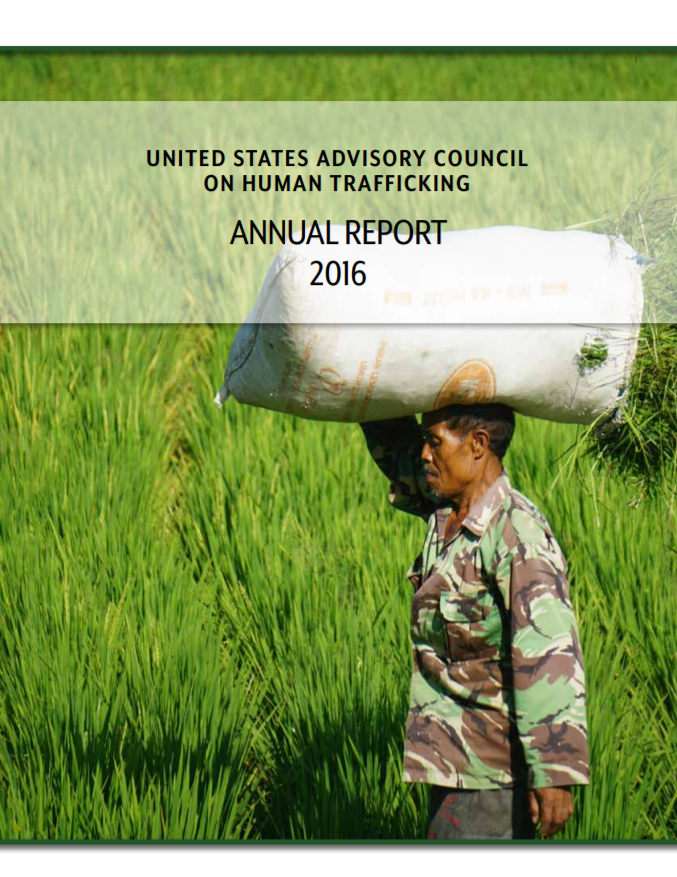
This report provides actionable recommendations to the U.S. government for its work both nationally and internationally, as it cooperates with state and local governments, NGOs, faithbased organizations, community members, businesses, and philanthropists to further engage sur vivors to prevent human trafficking and engrain sur vivors as allies for lasting solutions to this heinous crime. For each topic addressed, our report provides an over view, identifies three recommendations to improve federal anti-trafficking policies, and highlights areas for future cooperation. Before the release of our annual report in 2017, we ask that PITF agencies work with us to implement our recommendations.

United States Advisory Council for Human Trafficking Annual Report- United States Advisory Council on Human Trafficking, 2016, 2016 DOWNLOAD

post

page

attachment

revision

nav_menu_item

custom_css

customize_changeset

oembed_cache

user_request

wp_block

wp_template

wp_template_part

wp_global_styles

wp_navigation

wp_font_family

wp_font_face

acf-taxonomy

acf-post-type

acf-field-group

acf-field

ai1ec_event

exactmetrics_note

Ending child labour by 2025: A review of policies and programmes
Publications

The international community has declared that the persistence of child labour in today’s world is unacceptable and, in the Sustainable Development Goals, has renewed its commitment to eliminating all forms of child labour by 2025. This report aims...Read More

Increased Transparency of Forced Labour and Money Laundering in Seafood Supply Chains
Publications

This briefing paper by Liberty Shared sets out recent improvements to the transparency of supply chains and analysis techniques and resources being increasingly applied by civil society to identify where exploitative activities exist in a supply chai...Read More

Symposium: Modeling Modern Slavery Risk
Publications

In July 2018, the Walk Free Foundation released the latest Global Slavery Index (GSI), which presents estimates for the number of victims of modern slavery in 167 countries. Using data from the Gallup World Poll’s module on modern slavery, which w...Read More

TAGS:
Survival at the Expense of the Weakest? Managing Modern Slavery Risks in Supply Chains During COVID-19
COVID-19 resourcesPublications

This paper reflects on the implications of the Coronavirus (COVID-19) pandemic on modern slavery risks in supply chains. We first reason that the global supply and demand shock resulting from COVID-19 exacerbates workers’ vulnerability to modern s...Read More

TAGS: Global