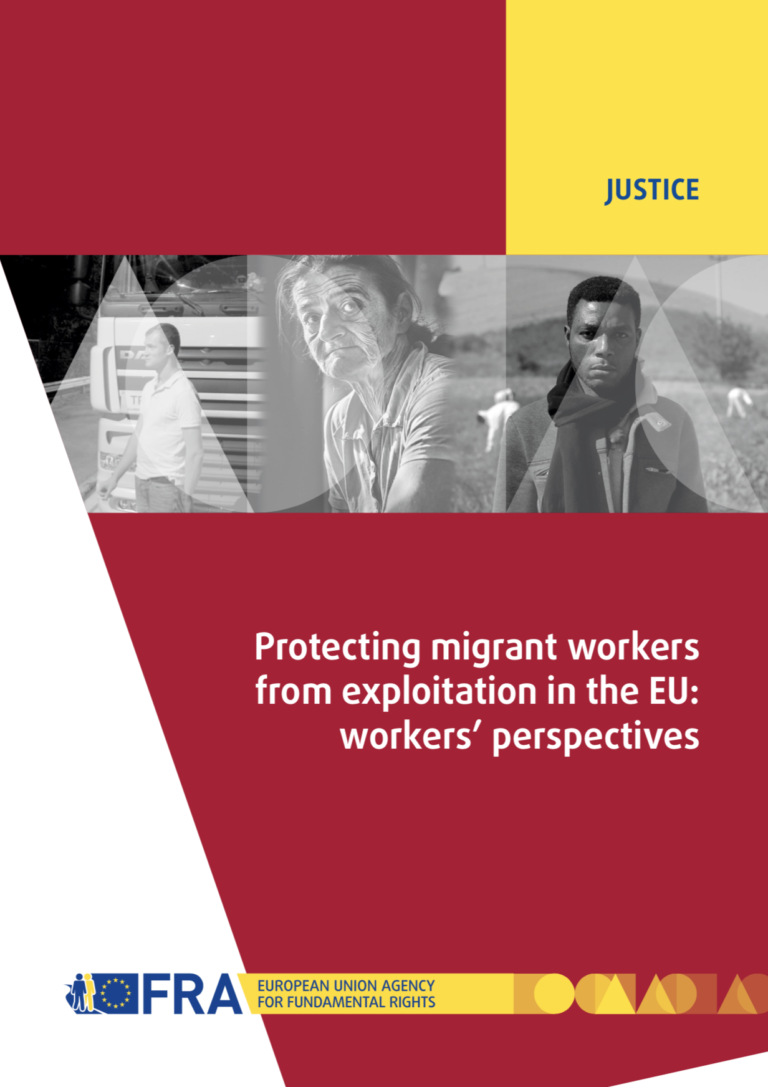
This report, the EU Fundamental Rights Agency’s fourth on the topic of severe labour exploitation, is based on interviews with 237 exploited workers – both people who came to the EU, and EU nationals who moved to another EU country. They were active in diverse sectors, and their legal status also varied. But their stories all paint a bleak picture of severe exploitation and abuse.

Respondents were forced to work for endless hours with no or little pay, often in dangerous settings and without minimum safety equipment; sleep in fields or construction sites, without access to toilets or running water; and suffer humiliating sexual harassment. They endured – and rarely reported – these violations out of fear of losing wages owed to them or, for those without a right to stay, of expulsion. As a result, labour inspectorates and law enforcement authorities uncover only few of these misdeeds, and offenders face little risk of being investigated or prosecuted. Impunity looms large.

This report shows how exploitation often starts with false promises and fraud, describes the extreme conditions the exploited workers endure, and identifies the factors that facilitate exploitation. But it also outlines what can be done to help exploited workers access justice.

Protecting migrant workers from exploitation in the EU: workers’ perspectives DOWNLOAD

post

page

attachment

revision

nav_menu_item

custom_css

customize_changeset

oembed_cache

user_request

wp_block

wp_template

wp_template_part

wp_global_styles

wp_navigation

wp_font_family

wp_font_face

acf-taxonomy

acf-post-type

acf-field-group

acf-field

ai1ec_event

exactmetrics_note

Sextortion: Findings from a Survey of 1,631 Victims
Publications

Janis Wolak and David Finkelhor Sextortion is defined as threats to expose a sexual image in order to make a person do something or for other reasons, such as revenge or humiliation. In an effort to better understand the threat of sextortion and ...Read More

Corruption and Contemporary Forms of Slavery: Examining Relationships and Addressing Policy Gaps
Publications

Corruption is an underlying cause of and a facilitating tool for practices arising from contemporary forms of slavery; it is essential to creating the conditions for a low-cost, low-risk, high-profit illicit trade in vulnerable individuals. Yet, cor...Read More

Building Communities of Resistance: Reflections from Grassroots Organisations Around the World
News & AnalysisPublications

This report is the result of a collective effort to pause, look inwards, and reflect on the process of transformative change. It collates a series of insights, challenges, and lessons learnt by and with ten grassroots organisations from Latin Americ...Read More

Anti-Trafficking Review: Special Issue–Sex Work
Publications

The Anti-Trafficking Review promotes a human rights-based approach to anti-trafficking. It explores trafficking in its broader context including gender analyses and intersections with labour and migration. It offers an outlet and space for dialogue...Read More

TAGS: