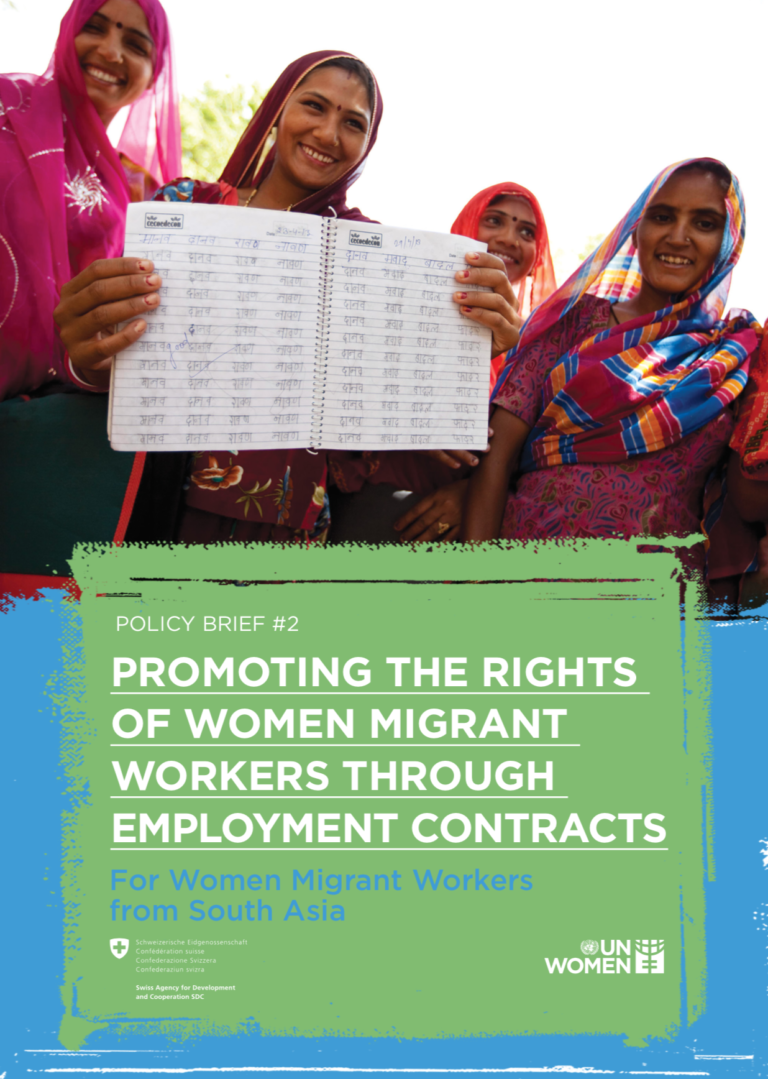
“Promoting the Rights of Women Migrant Workers through Employment Contracts” identifies and compares existing contract provisions in the South Asia – Middle East corridor and summarizes strengths and gaps in protection in line with common right violations reported by women migrant workers themselves. It makes recommendations on addressing these gaps by creating enforceable rights-based, gender-responsive employment contracts.

This article is the second part of a three-part Policy Brief series that identifies actions to develop and implement effective, rights-based and gender responsive protections for women workers migrating from South Asia to the Middle East. The policy briefs address three key stages during which protections for women migrant workers are developed, implemented, and monitored.

This policy brief series forms one part of the “Empowering Women Migrant Workers from South Asia: Toolkit for Gender-responsive Employment and Recruitment” which supports gender-responsive policies and practices to protect and promote the rights of women migrant workers from South Asia.

Migrant Workers in South Asia and the Middle East: Promoting the Rights of Women Migrant Workers Through Employment Contracts DOWNLOAD

post

page

attachment

revision

nav_menu_item

custom_css

customize_changeset

oembed_cache

user_request

wp_block

wp_template

wp_template_part

wp_global_styles

wp_navigation

wp_font_family

wp_font_face

acf-taxonomy

acf-post-type

acf-field-group

acf-field

ai1ec_event

exactmetrics_note

Power, Impunity and Anonymity. Understanding the Forces Driving the Demand for Sexual Exploitation of Children
Publications

This paper has been produced to support the Special Rapporteur on the sale of children, child pros tu on, and child pornography in the prepara on of the yearly thematic report planned to focus in 2016, on the demand for sexual exploitation of childr...Read More

Global Flagship Programme Implementation
Publications

The objective of the IPEC+ Global Flagship Programme – in line with target 8.7 of the 2030 Sustainable Development Agenda, adopted by the United Nations in 2015 – is to provide ILO leadership in global efforts to eradicate all forms of child la...Read More

Collaborating for freedom: anti-slavery partnerships in the UK
GuidancePublications

Multi-agency partnership working is often highlighted as an essential aspect of the UK public policy response to modern slavery. The Home Office’s (2014) Modern Slavery Strategy emphasises that effective partnership work is ‘crucial’ and must ...Read More

G7 Ministerial Declaration: Action for Fair Production
Publications

The declaration includes steps towards implementation of measures aimed at achieving responsible supply chains, such as: • Strengthening responsible supply chain management, particularly in SMEs; • Support for transparency initiatives for consu...Read More