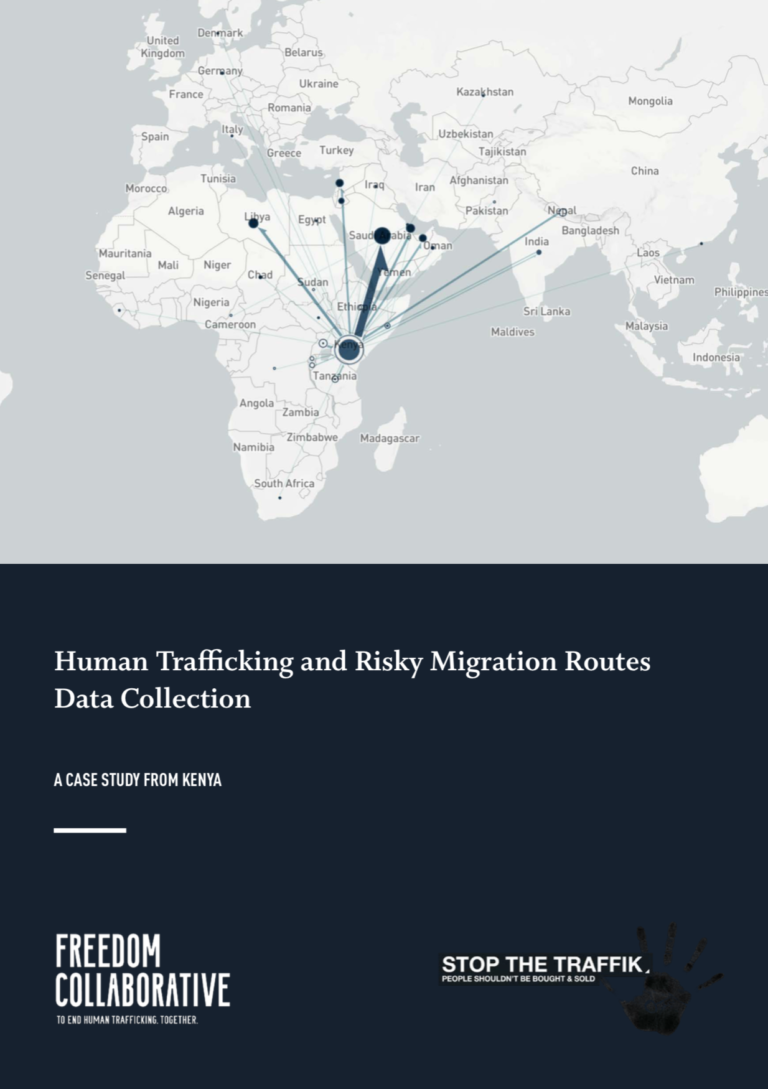
For the first time, comprehensive data is available for human trafficking and high risk migration routes relating to Kenya. The data identifies 38 countries as origin, transit and destination locations for abuse of victims – including eight countries in the Middle East/Gulf States, three countries in Europe, and five countries in Asia.

The data collection, which is a joint initiative between the national coalition Stop the Traffik-Kenya (STTK) and Freedom Collaborative, compiles the data from CSOs that work with survivors and at-risk populations in the country.

The results show the value of data sharing. They reveal some of the regional dynamics in the movement of people and human trafficking activity: There are clearly routes that are more commonly used by those involved in forced labour and human trafficking and the range of movement is extensive both in number of routes and distance covered.

The data shows Nairobi as a main destination for rural to urban migration from Kenya and surrounding countries, as well as a major transit hub for migration to Europe, Asia, and the Middle East. While Domestic Servitude and Commercial Sexual Exploitation are the most prevalent reported forms of exploitation, in total 17 different industries, sectors, and forms of trafficking were mentioned in the data.

The data was compiled using Freedom Collaborative’s Victim Journey Tracker tool and has been added to the global map of human trafficking routes.

Human Trafficking and Risky Migration Routes Data Collection: A Case Study from Kenya DOWNLOAD

post

page

attachment

revision

nav_menu_item

custom_css

customize_changeset

oembed_cache

user_request

wp_block

wp_template

wp_template_part

wp_global_styles

wp_navigation

wp_font_family

wp_font_face

acf-taxonomy

acf-post-type

acf-field-group

acf-field

ai1ec_event

exactmetrics_note

Preventing Trafficking in Persons: The Role of Public Procurement
Publications

This Inter-Agency Coordination Group against Trafficking in Persons (ICAT) Issue Brief explains the role of public procurement in preventing trafficking for forced labour. It outlines the international and national policy framework; elaborates on va...Read More

National Hotline 2017 Arkansas State Report
Graphics & InfographicsPublications

The data in this report represents signals and cases from January 1, 2017 through December 31, 2017 and is accurate as of July 11, 2018. Cases of trafficking may be ongoing or new information may be revealed to the National Hotline over time. Conseq...Read More

COVID-19 Impact on Child Labour and Forced Labour: The Response of the IPEC+ Flagship Program
COVID-19 resourcesPublications

The ILO’s Flagship International Programme on the Elimination of Child Labour and Forced Labour (IPEC+) has ongoing operations in 62 countries, all of which are affected by the COVID-19 pandemic. The programme has developed business continuity pla...Read More

TAGS: Global
Eliminating Child Labour in Malawi
Publications

British American Tobacco co‐founded the Eliminating Child Labour in Tobacco Growing Foundation (ECLT) in October 2000 and launched its pilot project in Malawi. This paper investigates the tobacco industry in Malawi. ...Read More