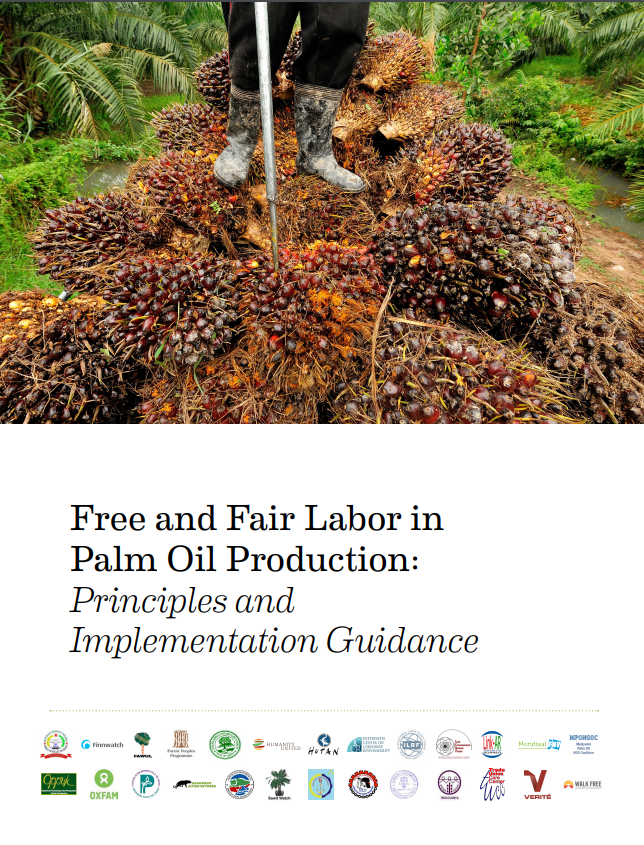
The Free and Fair Labor Principles (“Principles”) and corresponding Implementation Guidance (“Guidance”) is intended to support and advance the ongoing dialogue on responsible palm oil by providing a common point of reference on what constitutes free and fair labour in palm oil production.

It is based on the frameworks enshrined in International Labor Organization core conventions and the UN Guiding Principles on Business and Human Rights, and it builds on the existing standard established by the Roundtable on Sustainable Palm Oil (RSPO). It is not intended as a new code of conduct or certifiable standard, but rather as a resource to provide concrete and practical guidance on implementing responsible palm oil production.

Free and Fair Labor in Palm Oil Production: Principles and Implementation Guidance - Humanity United, 2015 DOWNLOAD

post

page

attachment

revision

nav_menu_item

custom_css

customize_changeset

oembed_cache

user_request

wp_block

wp_template

wp_template_part

wp_global_styles

wp_navigation

wp_font_family

wp_font_face

acf-taxonomy

acf-post-type

acf-field-group

acf-field

ai1ec_event

exactmetrics_note

Exposing the Hidden Victims of COVID-19
COVID-19 resourcesGuidancePublications

The COVID-19 pandemic is exposing just how fragile the protection and prevention framework on modern slavery is, despite progress in recent years resulting from a new focus, marked particularly by a drive toward national anti-slavery legislation. ...Read More

Tainted Stones: Bonded Labor and Child Labor in the India-U.S. Sandstone Supply Chain
Guidance

Three million workers are employed in India’s sandstone mining industry on a seasonal basis, with nearly 90% of India’s sandstone produced in the state of Rajasthan. Although the Government of Rajasthan has issued thousands of mining licenses an...Read More

We also have dreams: Ongoing safety and quality of life issues for Rohingya refugees in Bangladesh
Guidance

From October 2020 to April of 2021 BHRN interviewed 29 refugees ages 14 to 60 from 10 different camps in Cox’s BazarOf those interviewed 68% were women93% of refugees said they did not receive enough food rations72% described their current safety ...Read More

TAGS: Asia
Health and Human Trafficking in the Greater Mekong Subregion
Guidance

This study drew on a conceptual framework on trafficking and health that highlights the potential health influences of each of the phases of the migration process and their importance to the cumulative health status of individuals who are trafficked...Read More