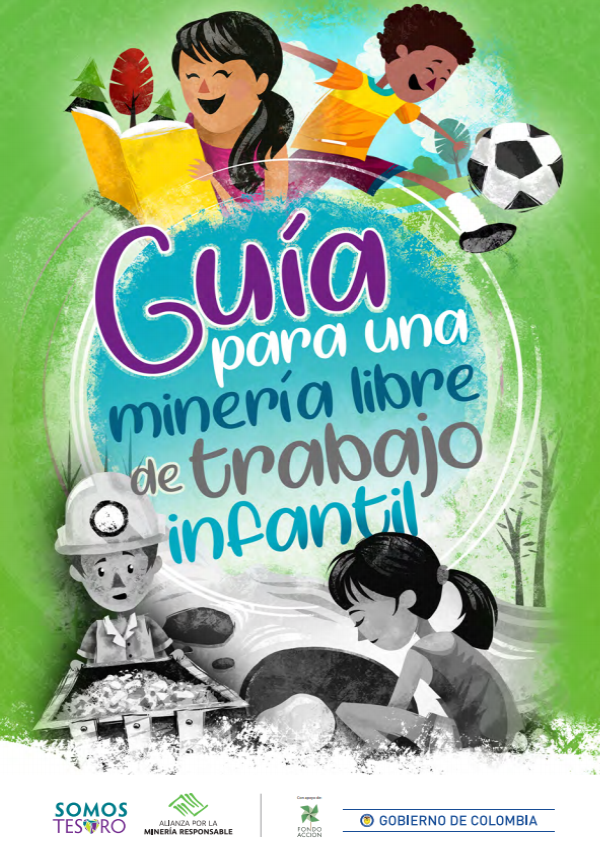
Esta guía contiene información relacionada con los derechos de los niños, niñas, adolescentes y sus familias; el fenómeno del trabajo infantil en Colombia y, de manera particular, en la minería.

También presenta la ruta de reporte del trabajo infantil, una herramienta que sirve para identificar los riesgos del trabajo infantil en una pequeña mina y los programas sociales que ofrecen las instituciones públicas y privadas, dirigidas a mitigar los efectos de la problemática en los territorios.

English version

This guide, created within the framework of the Somos Tesoro project and in collaboration with Minminas, Mintrabajo, ICBF and Fondo Acción, contains everything that a Colombian artisanal and small-scale miner must know about child labour.

The guide’s content was developed by combining the experience and knowledge of the entities involved and the results of a perception study on child labour carried out by ARM in 8 municipalities of Antioquia and Boyacá, where more than 300 miners participated.

Therefore, we present a didactic guide, written in a simple language, which explains: what rights children, adolescents and their families have and why they exist; the scope of the child labour problem in Colombia and, particularly, in mining; how to report and identify the risks of child labour in artisanal and small-scale mining; what actions the ICBF, Mintrabajo and Minminas are taking in case of encountering child labour; what the corresponding sanctions are; what social programs are offered by public and private institutions aimed at mitigating the effects of the problem in the territories; and finally how to apply for protected adolescent work authorizations.

child labour

Guía para una minería libre de trabajo infantil - Alianza por la Minería Responsable, 2018 DOWNLOAD

post

page

attachment

revision

nav_menu_item

custom_css

customize_changeset

oembed_cache

user_request

wp_block

wp_template

wp_template_part

wp_global_styles

wp_navigation

wp_font_family

wp_font_face

acf-taxonomy

acf-post-type

acf-field-group

acf-field

ai1ec_event

exactmetrics_note

Six steps to responsible recruitment: Implementing the employer pays principle
Guidance

A six step guide to implementing the Employer Pays Principles, in alignment with the UN Guiding Principles on Business and Human Rights. Reflecting the Dhaka Principles for Migration with Dignity, the Employer Pays Principle is a commitment to ensur...Read More

Relentless Resilience: Addressing Gender-Based Violence through Grassroots Excellence
Guidance

Relentless Resilience is a Beijing +25 Parallel Report that calls for holistic change to address the root causes of gender-based violence (gender inequity, systemic racism, colonialism, ableism, trans/homophobia, capitalism, etc.) and societal power...Read More

Updated Guide to Ethics and Human Rights in Anti-Trafficking: Ethical Standards for Working with Migrant Workers and Trafficked Persons in the Digital Age
Guidance

Prepared by Lisa Rende Taylor and Mark Latonero. As digital technologies such as mobile phones and social media are permeating the lives of people across the globe, more organizations working in anti-trafficking and responsible sourcing are seek...Read More

What works to end modern slavery? A review of evidence on policy and interventions in the context of justice
GuidancePublications

The purposes of the study was to examine what is known about effective policy to achieve SDG Target 8.7 in the context of justice, by: (1) collecting and collating existing evidence on what works; (2) identifying the range of claims and hypotheses c...Read More