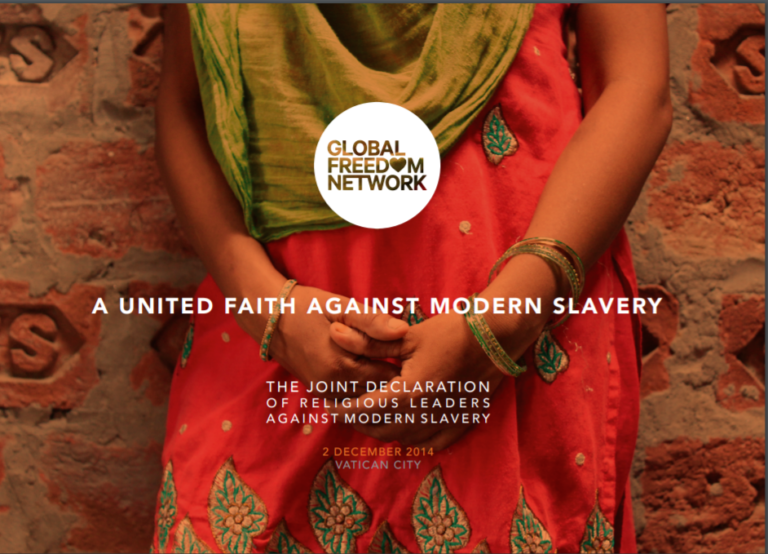
Modern slavery in all of its guises – such as human trafficking, forced labour, sexual exploitation and organ trafficking – is endemic in many countries. It often preys on society’s most vulnerable people, stripping them of their rights to freedom and dignity. It usually involves money, corruption and widespread abuses of power.

It has long been recognised that there can be no single way to end slavery; it is a crime that must be tackled at all levels, through all networks and with a broad range of resources. It must be challenged at its roots as well as dissolved in its myriad of branches and channels.

But how to reach into the many countries and communities that harbour modern slavery and put an end to it? And how to spread the message far and wide that modern slavery is a corrupt and evil abuse of core human values? The answers may well lie in the coming together of religions in a united front against slavery. If the teachings and application of various faiths reach up to 90 per cent of the world’s population, then there can be no greater way to influence the vast majority of the world’s population.

For it will be through the shifting of cultural norms and behaviours, complementing judicial, supply chain and international protocol enforcements, that sustained change will occur.

child labour

A United Faith Against Modern Slavery - Global Freedom Network, 2014 DOWNLOAD

post

page

attachment

revision

nav_menu_item

custom_css

customize_changeset

oembed_cache

user_request

wp_block

wp_template

wp_template_part

wp_global_styles

wp_navigation

wp_font_family

wp_font_face

acf-taxonomy

acf-post-type

acf-field-group

acf-field

ai1ec_event

exactmetrics_note

Independent Review of the Modern Slavery Act, Second Interim Report: Transparency in Supply Chains
Publications

It is clear that the Act is an innovative piece of legislation that has influenced parliaments across the world in efforts to combat the global evil of modern slavery. Other countries are following our lead, so it is of the utmost importance that we...Read More

Reclaiming Migrant Women’s Narratives: A Feminist Participatory Action Research Project on ‘Safe and Fair’ Migration in Asia
Publications

The report shows that Safe and Fair migration cannot happen in a silo – the factors that produce gender segregated labour markets, industries dependent on flexible, underpaid and overworked migrant labour require a systemic change. This change can...Read More

TAGS:
Child Labour: Global estimates 2020, trends and the road forward
Publications

This report warns that global progress to end child labour has stalled for the first time in 20 years. The number of children aged 5 to 17 years in hazardous work – defined as work that is likely to harm their health, safety or morals – has rise...Read More

Migrant and Child Labour in Thailand’s Shrimp and Other Seafood Supply Chains: Labour Conditions and the Decision to Study or Work
Publications

The study aims to strengthen the evidence base on child labour and the labour conditions of migrant workers in Thailand’s shrimp and other seafood supply chains, with a particular focus on communities engaged in these industries. Its objective is ...Read More