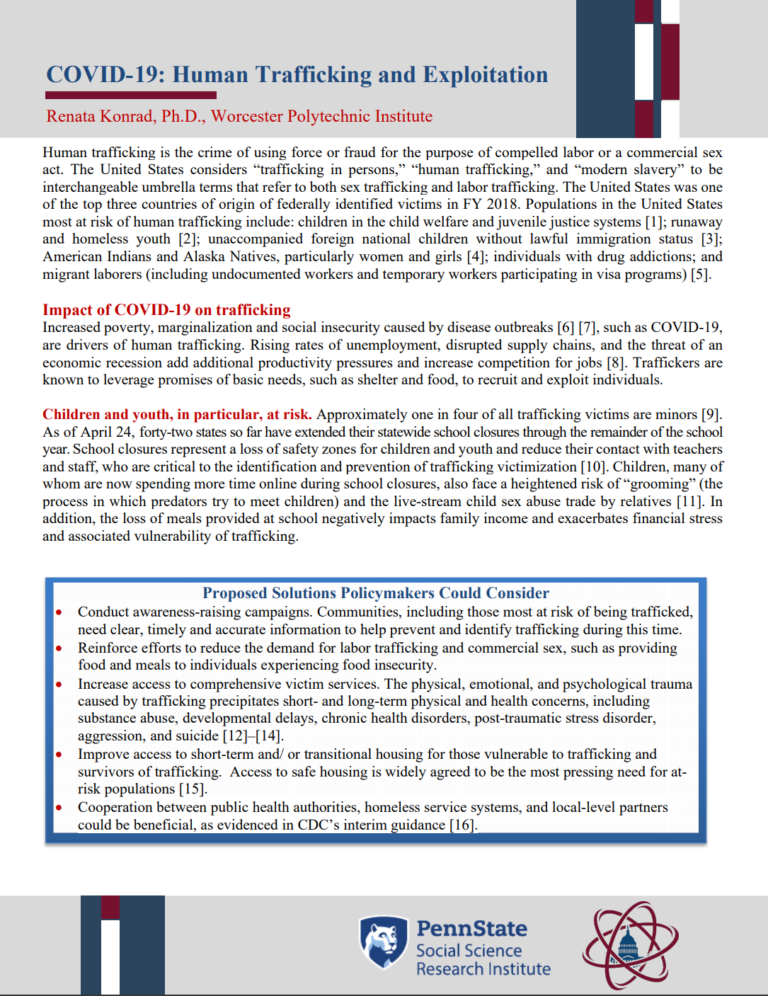
Human trafficking is the crime of using force or fraud for the purpose of compelled labor or a commercial sex act. The United States considers “trafficking in persons,” “human trafficking,” and “modern slavery” to be interchangeable umbrella terms that refer to both sex trafficking and labor trafficking. The United States was one of the top three countries of origin of federally identified victims in FY 2018. Populations in the United States most at risk of human trafficking include: children in the child welfare and juvenile justice systems; runaway and homeless youth; unaccompanied foreign national children without lawful immigration status; American Indians and Alaska Natives, particularly women and girls; individuals with drug addictions; and migrant laborers (including undocumented workers and temporary workers participating in visa programs).

COVID-19: Human Trafficking and Exploitation - Penn State Social Science Research Institute, 2020 DOWNLOAD

post

page

attachment

revision

nav_menu_item

custom_css

customize_changeset

oembed_cache

user_request

wp_block

wp_template

wp_template_part

wp_global_styles

wp_navigation

wp_font_family

wp_font_face

acf-taxonomy

acf-post-type

acf-field-group

acf-field

ai1ec_event

exactmetrics_note

From fish to fishworker traceability in Thai fisheries reform
Publications

This paper explores the question of what traceability systems mean for the labour situation of fish- workers; for whom and in what respects is traceability effective, and what impact do these systems have? The limited social criteria in fi...Read More

An Introduction & Commentary to the 2011 UN Guiding Principles on Business and Human Rights & their Implementation in the Maritime Environment
Publications

The commentary explains how and why the UN Guiding Principles on Business and Human Rights should apply throughout the maritime environment to all business enterprises and in all business operations throughout the maritime supply chain, both on land ...Read More

Risks and Considerations for Businesses with Supply Chain Exposure to Entities Engaged in Forced Labor and other Human Rights Abuses in Xinjiang
Publications

Businesses with potential exposure in their supply chain to the Xinjiang Uyghur Autonomous Region (Xinjiang) or to facilities outside Xinjiang that use labor or goods from Xinjiang should be aware of the reputational, economic, and legal risks of in...Read More

Maximizing Benefits from a Sustainable Supply Chain – BSR
Standards & Codes of ConductPublications

The case studies described in this brief reveal that there are benefits for suppliers to implementing social and environmental improvement programs, including improved workforce productivity, cost savings, and stronger competitiveness. Buyers also b...Read More