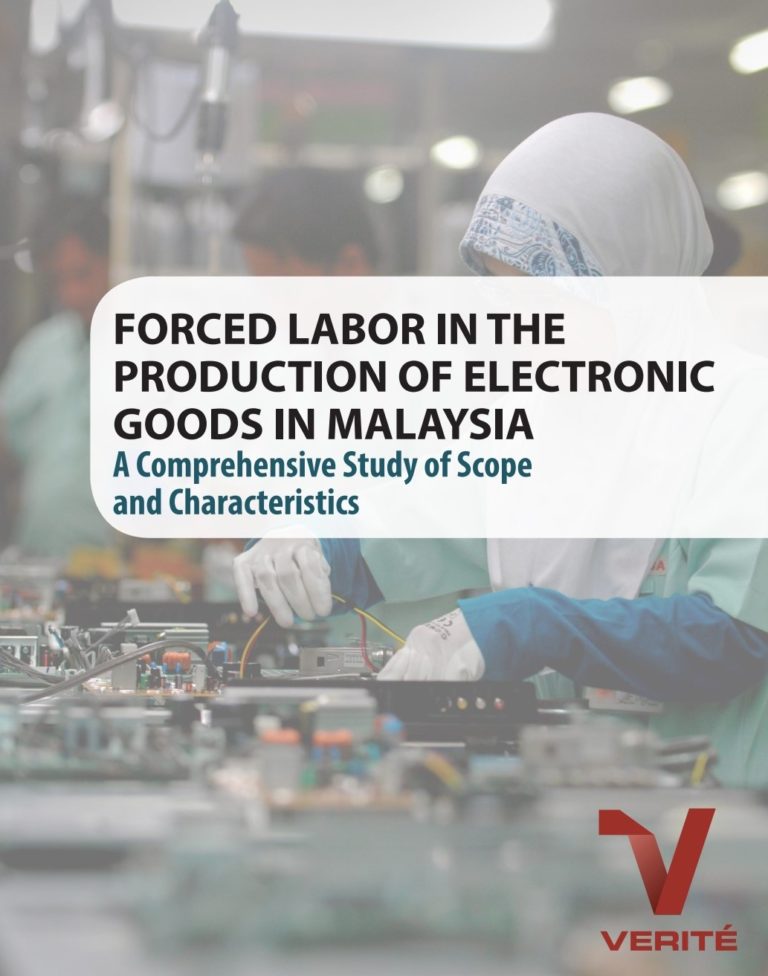
Malaysia’s electronics sector workforce includes hundreds of thousands of foreign migrant workers who come to Malaysia on the promise of a good salary and steady work – an opportunity to make a better life for themselves and their families. But many are subject to high recruitment fees, personal debt, complicated recruitment processes, lack of transparency about their eventual working conditions, and inadequate legal protections. Unscrupulous behaviour on the part of employers or third-party employment agents1 can exacerbate vulnerability to exploitation, but the system in which foreign workers are recruited, placed and managed is complex enough to create vulnerability even in the absence of willful intent to exploit. The conditions faced by foreign electronics workers in Malaysia have the potential to result in forced labour. In 2012, Verité received funding from the US Department of Labor to conduct a study to determine whether such forced labour does, in fact, exist in the production of electronic goods in Malaysia.

Forced Labor in the Production of Electronic Goods in Malaysia: A Comprehensive Study of Scope and Characteristics- Verité, 2014 DOWNLOAD

post

page

attachment

revision

nav_menu_item

custom_css

customize_changeset

oembed_cache

user_request

wp_block

wp_template

wp_template_part

wp_global_styles

wp_navigation

wp_font_family

wp_font_face

acf-taxonomy

acf-post-type

acf-field-group

acf-field

ai1ec_event

exactmetrics_note

Are you Complying with the EU Sustainability-related Disclosures Regulation?
Publications

The legal landscape for financial market participants (FMPs) regarding sustainability and human rights has drastically changed and more regulation is on its way, both at the EU and AT national levels. This briefing paper is meant to give a short ove...Read More

Looking for a Quick Fix – How Weak Social Auditing is Keeping Workers in Sweatshops
Publications

This report from 2005 researches the weaknesses of social auditing. Social audits to check working conditions in production facilities emerged in the mid-1990s after a number of high profile companies were widely scrutinized for substandard working ...Read More

National Hotline 2017 Minnesota State Report
Graphics & InfographicsPublications

The data in this report represents signals and cases from January 1, 2017 through December 31, 2017 and is accurate as of July 11, 2018. Cases of trafficking may be ongoing or new information may be revealed to the National Hotline over time. Conseq...Read More

Climate-induced migration and modern slavery
Publications

Climate change is devastating the planet, leading to intensifying global inequality as well as disputes over land, water, and scarce resources. People are being driven to migrate within and across borders in search of resources and income, making th...Read More