
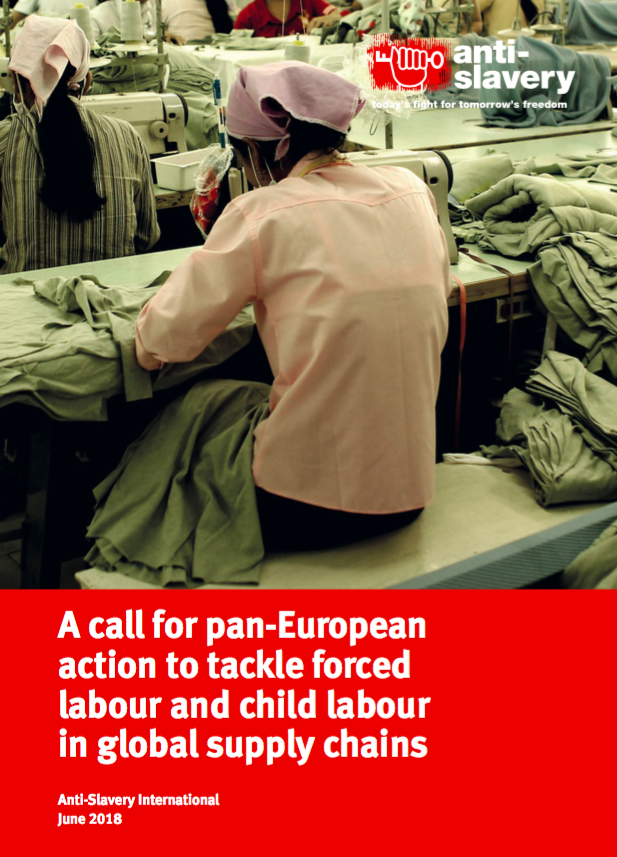
This briefing for European policy makers outlines the increased risk of forced and child labour, in global supply chains of goods and services. It argues that extant national and EU law and policies are insufficient to eradicate slavery in supply chains, since they cover only specific sectors (such as conflict minerals or timber) or generic transparency requirements. Anti-Slavery International calls for a systematic, pan-European approach to tackling forced and child labour in global supply chains that includes binding due diligence, requiring businesses to proactively tackle human rights abuses throughout their supply chains.

post

page

attachment

revision

nav_menu_item

custom_css

customize_changeset

oembed_cache

user_request

wp_block

wp_template

wp_template_part

wp_global_styles

wp_navigation

wp_font_family

wp_font_face

acf-taxonomy

acf-post-type

acf-field-group

acf-field

ai1ec_event

exactmetrics_note

Health and wellbeing of Nepalese migrant workers abroad 2018
Publications

Authors: Pratik Adhikary, (Faculty of Health and Social Sciences, Bournemouth University, Bournemouth, UK) Zoë A. Sheppard, (Faculty of Health and Social Sciences, Bournemouth University, Bournemouth, UK)Steven Keen,&n...Read More

It’s a Journey We Travel Together: Women Migrants Fighting for a Just Society
News & AnalysisPublications

This report describes the Feminist Participatory Action Research (FPAR) carried out by seven organisations from six countries across Asia and the Pacific region (Kyrgyzstan, Nepal, India, Malaysia, Indonesia and Hong Kong) between 2019 and 2021. The...Read More

National Hotline 2019 Massachusetts State Report
Graphics & InfographicsPublications

The data in this report represents signals and cases from January 1, 2019 through December 31, 2019 and is accurate as of July 30, 2020. Cases of trafficking may be ongoing or new information may revealed to the National Hotline over time. Consequen...Read More

How Companies can deal with Labour Exploitation in the Agricultural Sector
Publications

Abstract This short paper tends to shed light and reflect on the way forward for companies to address labour exploitation in their agricultural supply chain. For that, it will first refer to some of the cases reported in Spain and Italy to then br...Read More