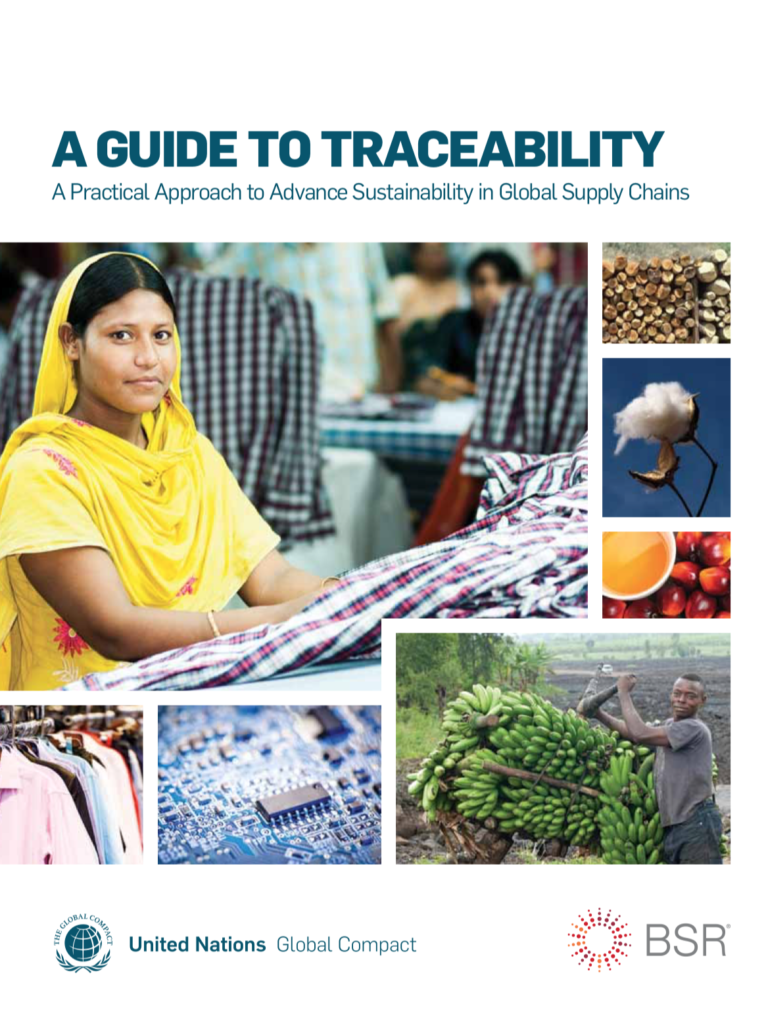
The purpose of the guide is to provide an overview of the importance of traceability for sustain- ability purposes, outline the global opportunities and challenges it represents and summarize practical steps for implementing traceability programmes within companies.

The guide is primarily aimed at supply chains, procurement, sourcing and sustainability profes- sionals who seek to improve the sustainability of their companies’ supply chains, and who are considering traceability. Individuals already engaged in traceability in some way and those who are new to the topic will gain value from this guide.

This guide is divided into three sections:
• In Part 1, the guide defines traceability and explores its history, benefits and challenges,
including an overview of current cooperative schemes on traceability;
• In Part 2, the guide demonstrates a model for best practice in traceability, and provides an overview of the different models of traceability and the global initiatives operating in
the arena;
• In Part 3, the guide provides guidance to companies around the world, large and small,
on how to effectively engage in traceability.

A Guide to Traceability: A Practical Approach to Advance Sustainability in Global Supply Chains - United Nations Global Compact and BSR, 2014 DOWNLOAD

post

page

attachment

revision

nav_menu_item

custom_css

customize_changeset

oembed_cache

user_request

wp_block

wp_template

wp_template_part

wp_global_styles

wp_navigation

wp_font_family

wp_font_face

acf-taxonomy

acf-post-type

acf-field-group

acf-field

ai1ec_event

exactmetrics_note

Commonwealth Modern Slavery Act 2018: Guidance for Reporting Entities
Guidance

The Commonwealth Modern Slavery Act 2018 established Australia’s national Modern Slavery Reporting Requirement (reporting requirement). The aim of this Guide is to explain in plain language what entities need to do to comply with the Act...Read More

TAGS: Oceania
How to prevent modern slavery: A report by Unseen based on data from the modern slavery & exploitation helpline and lived experience accounts
Guidance

In 2021, the number of people referred to the UK Government’s system of identification and support, the National Referral Mechanism (NRM), stood at 12,727. Of those, only 2,866 were given a Positive Conclusive Grounds decision, conf...Read More

Combating trafficking in human beings and labour exploitation in supply chains: Guidance for OSCE Procurement
Guidance

When moving towards mitigating or ultimately preventing trafficking in human beings and labour exploitation (THB/LE) in supply chains, a wider perspective is needed, one that includes human rights and decent working conditions. THB/LE is the extreme...Read More

Trafficking Victim Protection Frameworks in Cambodia, Indonesia, Lao PDR, Thailand, and Viet Nam: A Resource for Practitioners
GuidancePublications

This publication provides an overview of the legal and policy framework in place for the protection of trafficking victims in five countries in Southeast Asia (Cambodia, Indonesia, Lao PDR, Thailand, and Viet Nam), outlining the various instruments,...Read More