
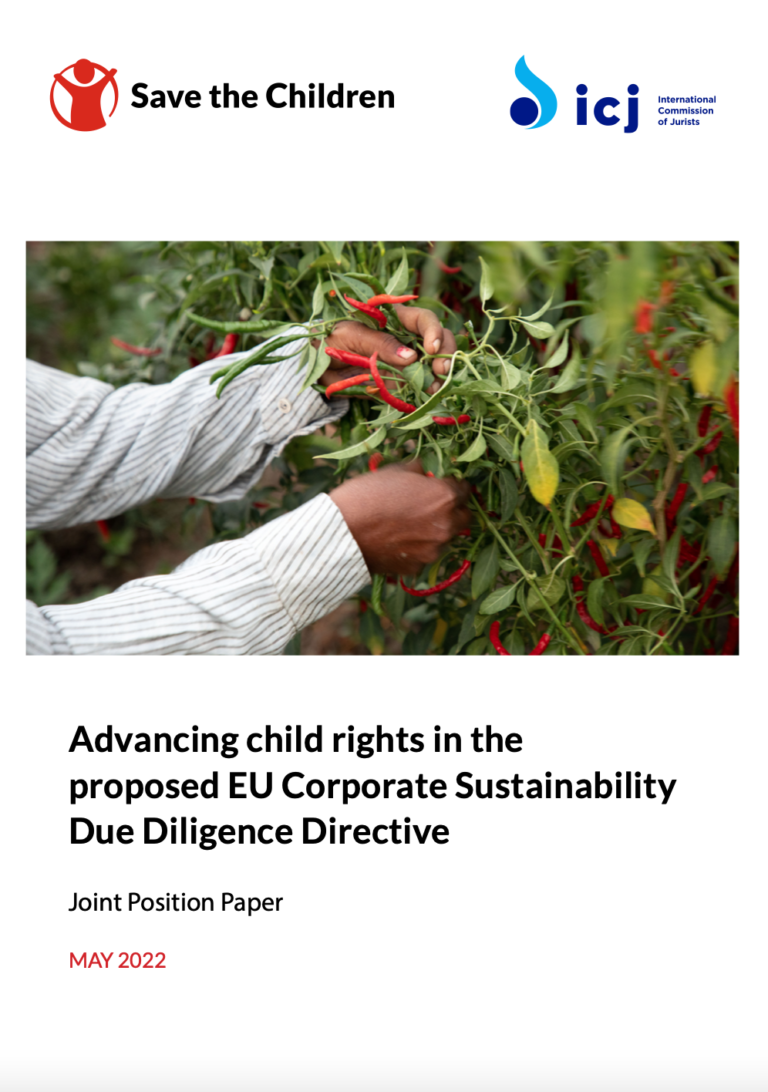
Following a roadmap and public consultation and several postponements, the European Commission published a draft Directive on Corporate Sustainability Due Diligence on 23 February 2022. The Draft Directive will now be negotiated within the European Parliament and the European Council with an estimated final adoption later this year or in 2023. The steps taken by European Union institutions to regulate business conduct in the form of the Directive are generally welcome, and the proposal itself contains a number of positive elements that should be maintained or developed.

Advancing child rights in the proposed EU corporate sustainability due diligence directive - Save the Children & International Commission of Jurists, May 2022 DOWNLOAD

post

page

attachment

revision

nav_menu_item

custom_css

customize_changeset

oembed_cache

user_request

wp_block

wp_template

wp_template_part

wp_global_styles

wp_navigation

wp_font_family

wp_font_face

acf-taxonomy

acf-post-type

acf-field-group

acf-field

ai1ec_event

exactmetrics_note

Combating trafficking in human beings and labour exploitation in supply chains: Guidance for OSCE Procurement
Guidance

When moving towards mitigating or ultimately preventing trafficking in human beings and labour exploitation (THB/LE) in supply chains, a wider perspective is needed, one that includes human rights and decent working conditions. THB/LE is the extreme...Read More

Identifying Trafficking Victims: An Analysis of Victim Identification Tools and Resources in Asia
Guidance

This review examines what victim identification tools and resources are publicly available, primarily in English, to support the identification and referral of trafficking victims, with a focus on countries in Asia. It is intended for policymakers a...Read More

A Checklist & Guidance for Assessing Compliance
Guidance

The aim of this checklist is to help compliance personnel perform better assessments. Such assessments are a key link in the implementation of corporate codes of conduct and enable auditors to identify forced labour at enterprise level and in globa...Read More

TAGS: Global
How Can I Manage the Risk of Modern Slavery in My Supply Chain? GFEMS Highlights Three Promising Forced Labor Risk Detection Tools
Guidance

The COVID-19 pandemic has increased workers’ vulnerability to modern slavery across global apparel and manufacturing supply chains1. In addition to exacerbating risks to workers, the pandemic has increased consumers’ visibility on where and...Read More