
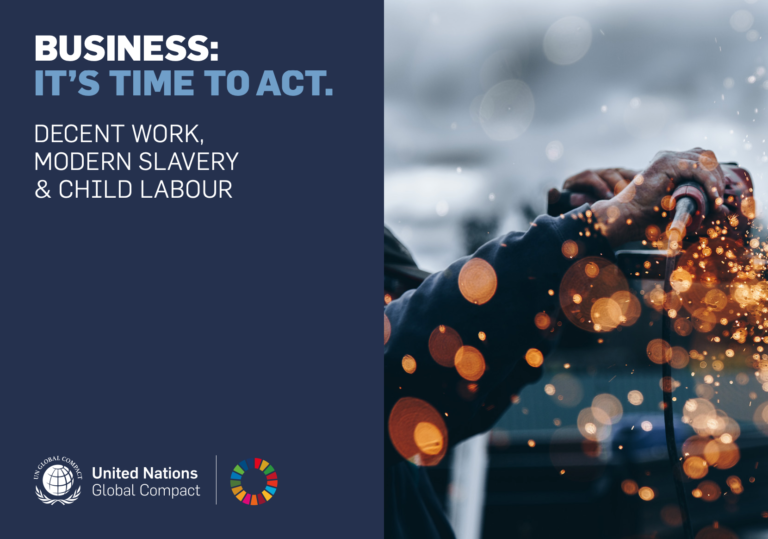
Decent work cannot exist where modern slavery and child labour persist. Forced labour, modern slavery and child labour are complex problems associated with poverty, governance failures and inequalities in the global labour market. Tackling them requires a massive international effort, involving Governments, businesses, civil society organizations, trade unions and international bodies. This brief guide, developed as part of the Decent Work in Global Supply Chains Action Platform, offers a quick overview of the steps businesses can take to help eliminate modern slavery, while highlighting key resources, initiatives and engagement opportunities to support business action.

Business: It's time to act - decent work, modern slavery & child labour - United Nations Global Compact, 2018 DOWNLOAD

post

page

attachment

revision

nav_menu_item

custom_css

customize_changeset

oembed_cache

user_request

wp_block

wp_template

wp_template_part

wp_global_styles

wp_navigation

wp_font_family

wp_font_face

acf-taxonomy

acf-post-type

acf-field-group

acf-field

ai1ec_event

exactmetrics_note

RMI Report 2022
Guidance

The RMI Report 2022 assesses the ESG policies and practices of 40 of the largest mining companies in the world, and basic ESG actions at 250 of their mine sites. Analysts scrutinised over 6,500 documents for the evidence-based assessment (without re...Read More

Інформація для сільськогосподарських працівників, які перебувають у Шотландії на підставі сезонної робочої візи, про їхні права й підтримку
COVID-19 resourcesGuidance

Дана брошура створена задля надання мігрантам, які працюють у сфері сільського господарства за програмою Seasonal Workers’ Pilot у Шотландії, ві...Read More

TAGS:
Appropriations Briefing Book
GuidanceGood Practices

This briefing book provides concrete recommendations from the Alliance to End Slavery and Trafficking (ATEST) that articulate how Congress can provide resources that are critical to ensure that the U.S. government is taking a comprehensive, victim-c...Read More

COVID-19: How to include marginalized and vulnerable people in risk communication and community engagement
COVID-19 resourcesGuidance

Women, the elderly, adolescents, youth, and children, persons with disabilities, indigenous populations, refugees, migrants, and minorities experience the highest degree of socio-economic marginalization. Marginalized people become even more vulnera...Read More

TAGS: Global