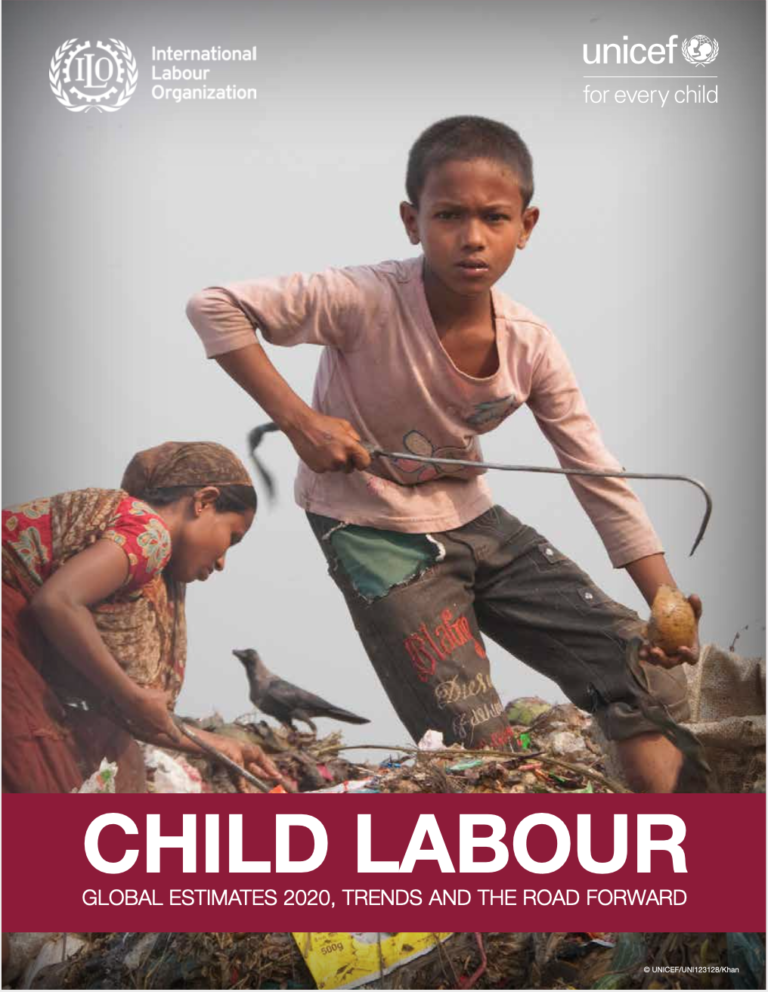
This report warns that global progress to end child labour has stalled for the first time in 20 years. The number of children aged 5 to 17 years in hazardous work – defined as work that is likely to harm their health, safety or morals – has risen by 6.5 million to 79 million since 2016. In sub-Saharan Africa, population growth, extreme poverty, and inadequate social protection measures have led to an additional 16.6 million children in child labour over the past four years. Additional economic shocks and school closures caused by COVID-19 mean that children already in child labour may be working longer hours or under worsening conditions, while many more may be forced into the worst forms of child labour due to job and income losses among vulnerable families. The report warns that globally 9 million additional children are at risk of being pushed into child labour by the end of 2022 as a result of the pandemic. Children in child labour are at risk of physical and mental harm. Child labour compromises children’s education, restricting their rights and limiting their future opportunities, and leads to vicious inter-generational cycles of poverty and child labour.

Child Labour: Global estimates 2020, trends and the road forward - UNICEF/ILO joint publication, 2021 DOWNLOAD

post

page

attachment

revision

nav_menu_item

custom_css

customize_changeset

oembed_cache

user_request

wp_block

wp_template

wp_template_part

wp_global_styles

wp_navigation

wp_font_family

wp_font_face

acf-taxonomy

acf-post-type

acf-field-group

acf-field

ai1ec_event

exactmetrics_note

11th General Report on GRETA’s Activities
GuidancePublications

This year’s General Report zooms in on the impact of information and communication technology (ICT) on trafficking in human beings. Countries monitored by GRETA have reported an increased use of ICT for recruiting and controlling victims of traffi...Read More

TAGS: Europe
National Hotline 2017 Connecticut State Report
Graphics & InfographicsPublications

The data in this report represents signals and cases from January 1, 2017 through December 31, 2017 and is accurate as of July 11, 2018. Cases of trafficking may be ongoing or new information may be revealed to the National Hotline over time. Conseq...Read More

Impact of the CARE Tipping Point Program in Nepal on adolescent girls’ agency and risk of child, early, or forced marriage: Results from a cluster-randomized controlled trial
Publications

ackground: Girl child, early, and forced marriage (CEFM) persists in South Asia, with long-term effects on well- being. CARE’s Tipping Point Initiative (TPI) sought to address the gender norms and inequalities underlying CEFM by engaging part...Read More

TAGS:
Special Issue – Trafficking in Minors
Publications

This Special Issue of Anti-Trafficking Review focuses on the phenomenon of trafficking in minors in different contexts and from a variety of perspectives. These include its relationship to child labour and adolescent migration, online sexual explo...Read More

TAGS: Global