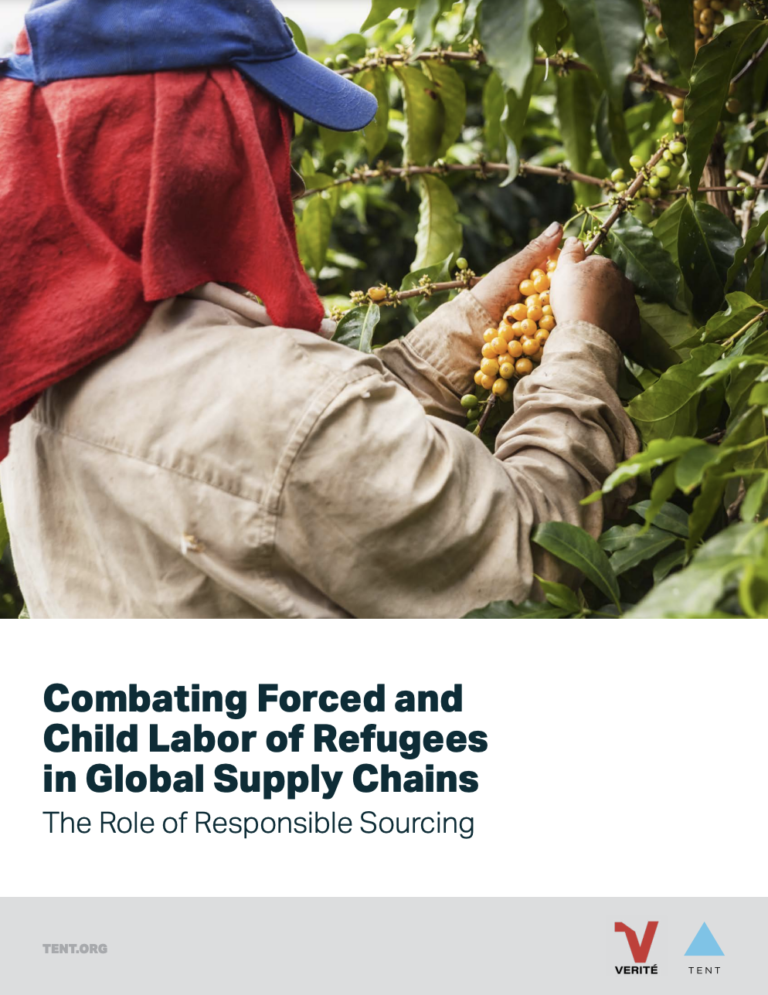
With the global refugee crisis showing no signs of abating, multinational companies need to consider how their supply chain interacts with refugees, who are often more vulnerable to forced labor when they seek out work in a new country. Combating Forced Labor and Child Labor of Refugees in Global Supply Chains: The Role of Responsible Sourcing unpacks why and how companies can and should tackle the issue of forced labor by rethinking how refugees can be safely integrated into their supply chains and, in doing so, help refugees gain access to fair, decent work.

This report makes the case for why companies should proactively include refugees in their strategies to mitigate the risk of forced labor. It also lays out concrete actions companies can take — by proactively encouraging their suppliers to hire refugees and by advocating for refugees’ expanded right to work, with recommendations and resources for companies and their responsible sourcing teams.

Combating Forced and Child Labor of Refugees in Global Supply Chains: The Role of Responsible Sourcing - Tent Partnership for Refugees and Verité, 2021 DOWNLOAD

post

page

attachment

revision

nav_menu_item

custom_css

customize_changeset

oembed_cache

user_request

wp_block

wp_template

wp_template_part

wp_global_styles

wp_navigation

wp_font_family

wp_font_face

acf-taxonomy

acf-post-type

acf-field-group

acf-field

ai1ec_event

exactmetrics_note

Understanding and Responding to Modern Slavery within the Homelessness Sector
GuidancePublications

Homelessness organisations and anti-slavery organisations have both been aware of links between modern slavery and homelessness, yet there has been little research into how these issues overlap and impact on one another. An initial scoping exercise ...Read More

Child Labor in the Coffee Sector in Eastern Uganda
Guidance

Child labor in coffee production in Eastern Uganda is widespread. Engaged in such activities as picking and sorting berries or transporting beans and supplies, children working in Uganda’s coffee supply chain (CSC) experience risks to their safety...Read More

TAGS: Africa
Reality Behind Brands’ CSR Hypocrisy: An Investigative Report on China Suppliers of ZARA, H&M, and GAP
Publications

In the spring of 2015 and 2016, SACOM conducted undercover investigations inside four of Zara, H&M, and GAP’s supplier factories in China. Despite three brands’ CSR policies appear to be comprehensive and enable them to proclaim ethical, SA...Read More

Organising precarious workers in the Global South
Guidance

The workers of the world face numerous challenges. Many debates around the future of labour, such as the rise of the so called ‘gig economy’, tend to focus on experiences and trends within the Global North. The shortcomings of the present are of...Read More